What the step up from $50 actually buys
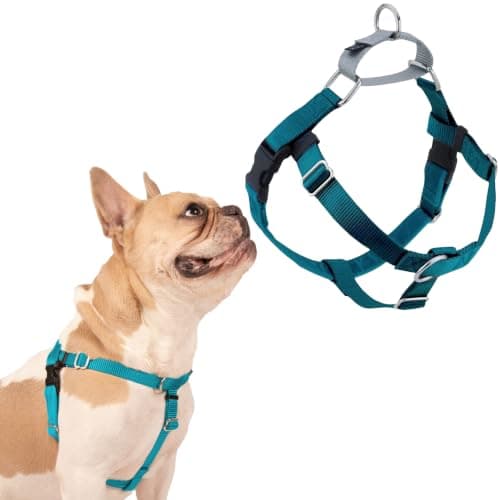
If you have read our under-$50 roundup, the honest question is what the extra money adds, because that band already contains the two best mechanisms in the category — the 2 Hounds Freedom’s front-ring-plus-martingale and the Kurgo’s steel buckle. The step up buys exactly two things, and neither is control.
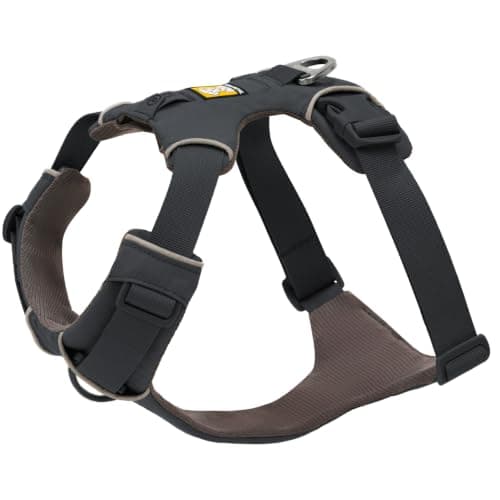
The first is a body that holds its shape on an awkward dog. The Front Range’s four independent adjustment points and foam-lined panels mean the harness keeps the front ring where you set it on a deep-chested or narrow-waisted dog, which is the failure mode that makes people think no-pull harnesses do not work. On a barrel ribcage above a tucked-up waist, a two-strap harness slides forward and up toward the throat — our page on harnesses for deep-chested dogs covers that shape specifically.
The second is escape resistance, and only one pick here has it. The Web Master adds a third strap behind the ribcage, which removes the cone-shaped gap a two-strap harness leaves behind the front legs — the shape a determined dog reverses out of. Nothing cheaper in this band does that. If your dog has ever backed out of a harness on a walk, that single feature is the reason to spend into the top of the band, and escape-proof harnesses under $100 is the page written around it.
How to choose between these five
- One harness, active dog, several years: Ruffwear Front Range.
- Your dog genuinely drags you and you want maximum redirection: 2 Hounds Freedom, on a double-ended leash clipped to both the chest ring and the back martingale loop. That pairing is steering rather than braking.
- Your dog backs out of harnesses: Ruffwear Web Master. Buy it for the third strap, not the aluminum ring.
- Your dog is hard on gear, or also rides in the car: Kurgo Tru-Fit. A steel nesting buckle rather than a plastic side-release, and crash testing its maker ran to the FMVSS 213 child-restraint standard — see harnesses for walking and driving for how far one harness honestly covers both jobs.
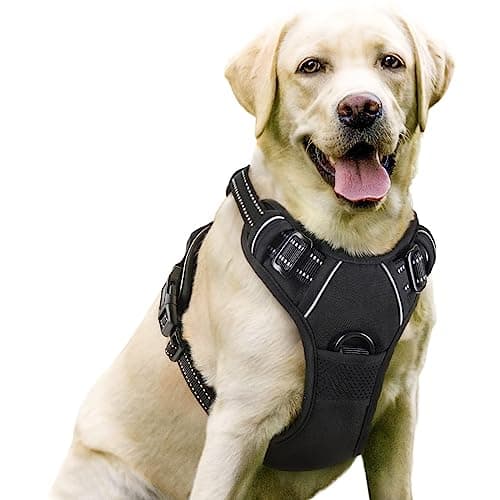
- You want the mechanism and nothing else: rabbitgoo. A front ring, a back ring, a padded vest and a grab handle, with a shorter service life stated plainly.
The thing no price band can buy
Fit. A hundred-dollar harness fitted loose controls a dog worse than a sixteen-dollar one fitted properly, and the most common reason an owner concludes “no-pull harnesses don’t work” is a chest strap sitting two inches too low or a girth strap left slack. Measure the girth behind the front legs before you buy, use the brand’s chart rather than its S/M/L label, and tighten to a two-finger fit. Our sizing guide walks it through, and no-pull harness not working lists the fixes in the order worth trying them.
A harness also manages pulling rather than curing it. The cure is reward-based loose-leash training; the harness is what makes today’s walk survivable while that work happens, and training harnesses covers which features actually help during a session.
Two cases take you out of this band entirely. If your dog barks and lunges at other dogs or people, the problem is arousal and distance rather than leash mechanics, and a head halter often beats any harness at any price — start at reactive gear under $50. And if you want the honest bottom of the market rather than the middle, no-pull harnesses under $30 is the tighter band and says what you give up by staying in it.