The three mechanisms on this page, in plain terms
Escape-proofing is not one feature, and knowing which of the three you need is worth more than the price difference between any two picks here.
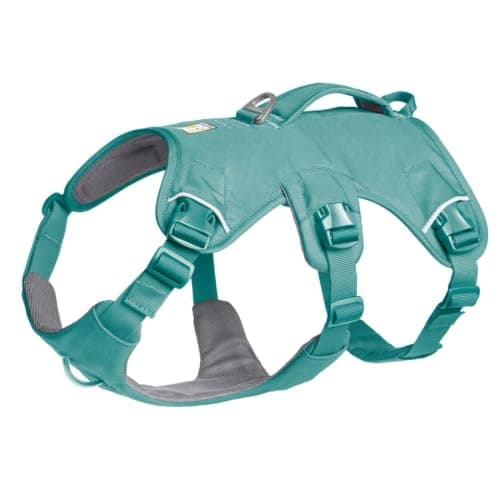
A third strap. The Web Master runs a strap behind the ribcage, aft of the normal girth strap. A dog escapes a harness by backing up and ducking its shoulders through the loop in front of its chest; the third strap means that when the shoulders come back, there is still a closed band around the narrowest part of the body. Ruffwear also puts a padded top handle and three attachment points on it, which is why it is also the pick on our escape-proof harnesses with a handle page.
A martingale loop. The 2 Hounds Freedom takes a different route: a loop across the back that draws gently closed as the dog surges. It tightens during the moment a dog would back out, which is better than a static strap for a dog whose escape attempt is really a side-effect of a hard pull. It is the right pick for the pull-and-escape dog, which is common enough that we built a whole page for it.
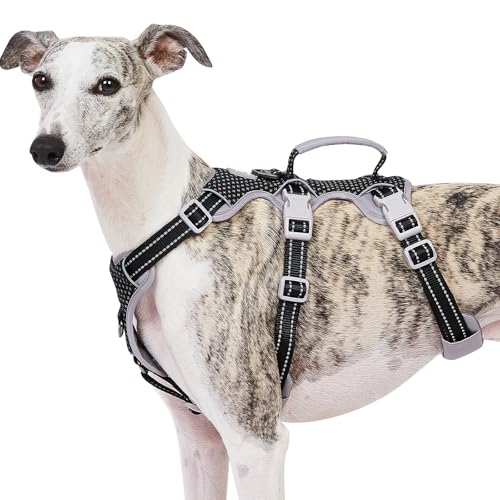
Adjustment points. The Huntboo publishes five, with four quick-release buckles, which is more than either Ruffwear. That is genuinely useful on an oddly-proportioned dog, and it is not the same as a third strap: it closes gaps a fixed-size vest leaves rather than changing the harness’s shape. Its honest caveats are in its write-up above — no brand website, no girth figures in the listing text, each size sold as a separate listing — so measure before you order.
How to choose between these four
- Your dog has escaped a fitted harness and run: Ruffwear Web Master. Pay for the geometry.
- Your dog hauls on the leash and comes out of things when it does: 2 Hounds Freedom, on a double-ended leash.
- Your dog is an awkward shape and your budget is tight: Huntboo HD03. Five adjustment points for budget money.
- Your dog is small or toy-sized: Gooby Escape Free Sport. A padded mesh vest with an extra rear strap sized for a small dog’s escape motion, and the cheapest pick here. Note it is back-clip only, so it is a security tool rather than a no-pull tool.
Fit is still the thing that decides it
More than in any other corner of this site. An escape-proof harness fitted loose is a normal harness, and most “my dog escapes any harness” cases are a girth strap two fingers too slack. Measure the girth behind the front legs, use the brand’s chart rather than its S/M/L label, and set every strap — our sizing guide covers the measurements and how tight a harness should be covers the two-finger test. Then read what makes a harness escape-proof, which is the page that explains the geometry rather than selling it, and how to stop a dog backing out for the handling changes that cost nothing.
Two honest limits. First, nothing here is a guarantee: a harness lowers the odds of an escape, and a long line in open space plus a tag and a microchip are what cover the remaining risk. Second, if the escaping is driven by panic — fireworks, traffic, a dog that freezes then thrashes — then gear is managing a symptom, and our picks for anxious dogs and newly-adopted rescue dogs are written around that case.
Finally, if your dog pulls as well as escapes and you are weighing the two budgets against each other, our no-pull harnesses under $100 page covers the same band from the control side, and martingale collar vs harness settles the question people usually ask next.