LEASH LOAM

Best Harnesses for Dogs That Pull and Escape

A dog that drags you down the block and then reverses out of its harness needs two mechanisms in one piece of gear. These are the four that have both — and the honest cost of each.

By Stephen V.Last verified How we pick

Buy the 2 Hounds Design Freedom — it is the only harness here whose security mechanism and its no-pull mechanism are the same part. The back strap is a martingale loop that draws closed when the dog surges, so the harness tightens at the exact moment an escaper would otherwise find slack to reverse through, and the front chest ring redirects that surge at the same time. If your dog has already escaped from something, the Ruffwear Web Master is the most secure design we rank, with a third strap behind the ribcage and a handle to grab. The budget pick is the Huntboo Escape Proof HD03: it publishes five adjustment points and a front metal D-ring, which is the cheapest route to a snug fit and a chest attachment. For a small dog that panics and spins, the Gooby Escape Free Sport is built around that specific motion.

This page exists because the two problems are usually one problem, and the usual advice treats them separately. Our no-pull roundup ranks on redirection, and two of its picks have no escape feature whatsoever. Our escape-proof roundupranks on security, and its top pick is honest about redirecting a pull less well than a dedicated front-clip harness. If your dog does both, you need a harness that was not designed around only one of them — and the shortlist is short.

Prices are not written into this page. The number inside each buy button is pulled from the live listing with the date it was taken, which is the only kind of price we are willing to stand behind; in prose we stay with brackets. The Huntboo and the Gooby are the budget end here, the Freedom is the middle, and the Web Master is the premium option. Every pick below was live and purchasable at our last price check.

How this is funded:we earn a commission if you buy through our links, at no extra cost to you. It never changes which product we recommend, and we’ll tell you plainly when we’d skip one. Full disclosure.

Quick picks

Ranked on design, published specs and buyer fit. Select a row to jump to the full write-up. We have not hand-tested these — here is exactly what we do instead.

#ProductBest forPrice
1
2 Hounds Design Freedom No-Pull Harness

2 Hounds Design Freedom No-Pull Harness

For the dog that pulls AND backs out, the Freedom's martingale loop is the trick: when the dog surges the harness snugs down rather than opening up, so it fights the very motion an escaper uses. Not a three-strap fortress, but far harder to reverse out of than a plain vest.

Best overall for both problems
$34.98 · View on Amazon

Price as of November 12, 2026. #ad How we’re funded

2
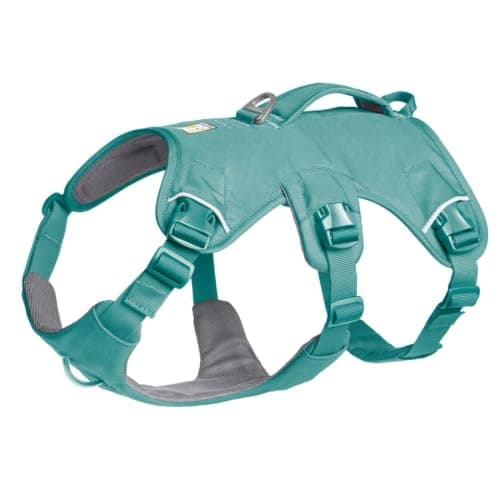
Ruffwear Web Master Harness

Ruffwear Web Master Harness

The harness to buy when your dog backs out of everything else. A third strap behind the ribcage closes the gap a two-strap harness leaves, so there is no shape for the dog to reverse out of — and a padded top handle lets you hold on or lift.

Most secure, if escaping is the bigger risk
$79.99 · View on Amazon

Price as of November 12, 2026. #ad How we’re funded

3
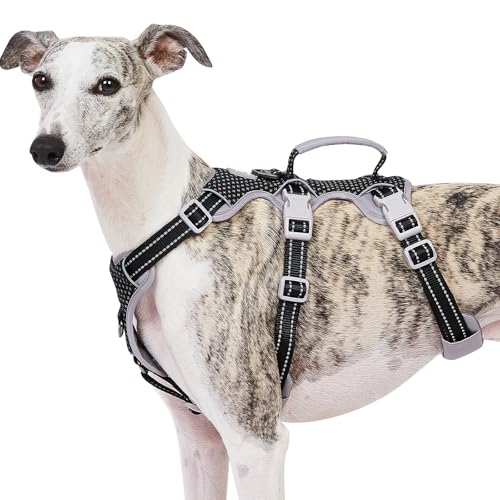
Huntboo Escape Proof Dog Harness (HD03)

Huntboo Escape Proof Dog Harness (HD03)

The most adjustable escape harness we rank, and the cheapest route to five-point fit: Huntboo publishes 5 adjustment points and 4 quick-release buckles, so you can close the gaps a two-strap vest leaves open rather than accept the gaps a size chart gives you. It is a fit-first design, not a third-strap design like the Web Master, and Huntboo publishes no strength rating and no brand website - so it earns its place on adjustability and a padded handle, not on proven hardware.

Budget pick with a front ring
$34.98 · View on Amazon

Price as of November 12, 2026. #ad How we’re funded

4
Gooby Escape Free Sport Harness

Gooby Escape Free Sport Harness

Built specifically for the small dog that slips its harness the moment it panics. The extra rear strap and snug vest shape are designed around a toy dog's ability to spin and reverse out — the small-breed answer to the Web Master.

Best for small dogs that spin out
$33.75 · View on Amazon

Price as of November 12, 2026. #ad How we’re funded

The picks in full

#1Best overall for both problems

2 Hounds Design Freedom No-Pull Harness

For the dog that pulls AND backs out, the Freedom's martingale loop is the trick: when the dog surges the harness snugs down rather than opening up, so it fights the very motion an escaper uses. Not a three-strap fortress, but far harder to reverse out of than a plain vest.

Strengths

  • Martingale action tightens on a surge instead of loosening
  • Velvet-lined belly strap keeps it comfortable when snug
  • Doubles as one of the best no-pull harnesses you can buy

Trade-offs

  • Not a dedicated three-strap escape harness like the Web Master
  • A committed Houdini can still work a two-strap design given time
TypeMartingale no-pull harness (escape-resistant)
AttachmentFront (chest) & back (martingale loop)
FitsXS–XL · sized by chest girth
MaterialNylon webbing, velvet-lined belly strap
Escape securityMartingale cinches on a surge, resisting backing-out
Best forAll sizes; strong pullers who wriggle

Specs read from the product listing, on July 22, 2026. “Not published” means the brand does not state that figure.

#2Most secure, if escaping is the bigger risk

Ruffwear Web Master Harness

The harness to buy when your dog backs out of everything else. A third strap behind the ribcage closes the gap a two-strap harness leaves, so there is no shape for the dog to reverse out of — and a padded top handle lets you hold on or lift.

Strengths

  • Three straps instead of two — removes the loop a dog backs out through
  • Padded top handle for close control or lifting over obstacles
  • Foam-lined, secure, and genuinely hard to escape when fitted snugly

Trade-offs

  • A security harness first — the chest loop redirects a pull, but a dedicated front-clip harness does it better
  • Premium price, and overkill for a dog that has never escaped
Type3-strap escape-proof harness with handle
AttachmentThree — back aluminum V-ring, back webbing loop, chest loop
FitsXXS–XL · sized by girth
MaterialFoam-lined nylon, three-strap body
Escape securityThird strap behind the ribs closes the escape gap
Best forAll sizes; the go-to for determined escapers

Specs read from the product listing, on July 22, 2026. “Not published” means the brand does not state that figure.

#3Budget pick with a front ring

Huntboo Escape Proof Dog Harness (HD03)

The most adjustable escape harness we rank, and the cheapest route to five-point fit: Huntboo publishes 5 adjustment points and 4 quick-release buckles, so you can close the gaps a two-strap vest leaves open rather than accept the gaps a size chart gives you. It is a fit-first design, not a third-strap design like the Web Master, and Huntboo publishes no strength rating and no brand website - so it earns its place on adjustability and a padded handle, not on proven hardware.

Strengths

  • 5 published adjustment points - the widest fit window here, which is what actually closes an escape route
  • 4 quick-release buckles, so it opens wide instead of being forced over the head
  • Padded lift handle plus full-body reflective fabric and both a front and a back metal D-ring

Trade-offs

  • No brand website and no published strength, girth or weight ratings - the Amazon listing is the only spec sheet
  • Fit does the work here: there is no third strap behind the ribs like the Ruffwear Web Master, so a sloppy fit is an escape
  • Four buckles and five straps mean a longer first fitting, and more webbing on the dog than a minimal harness
Type5-point-adjustable escape-proof harness
AttachmentFront (chest metal D-ring) & back (metal D-ring)
FitsNot published
MaterialReflective fly-woven fabric, breathable padded air mesh, 4 mm foam
Escape security5 adjustment points to close the gaps a fixed-size vest leaves
Best forS-XL; each size is a separate listing - measure first

Specs read from the product listing, on October 31, 2026. “Not published” means the brand does not state that figure.

#4Best for small dogs that spin out

Gooby Escape Free Sport Harness

Built specifically for the small dog that slips its harness the moment it panics. The extra rear strap and snug vest shape are designed around a toy dog's ability to spin and reverse out — the small-breed answer to the Web Master.

Strengths

  • Designed around small-dog escape geometry, not scaled down from a big-dog harness
  • Extra rear strap for security without a bulky build
  • Lightweight enough for toy breeds to wear comfortably

Trade-offs

  • Aimed at small dogs — not the pick for a large, powerful escaper
  • Back-clip design; it is about security, not no-pull redirection
TypeSmall-dog escape-proof harness
AttachmentBack (D-ring)
FitsXS–L · small-breed focused
MaterialPadded mesh vest, extra rear strap
Escape securityExtra rear strap sized to small-dog escape motion
Best forSmall & toy breeds

Specs read from the product listing, on July 22, 2026. “Not published” means the brand does not state that figure.

Why pulling and escaping are the same problem

Watch a dog actually get out of a harness and the sequence is almost always the same: it surges forward, hits the end of the leash, then throws its weight backwardagainst the resistance. A standard two-strap harness is a neck loop and a girth loop joined by a chest strap — which, when the dog reverses, becomes a cone the shoulders can slide out of. The harder the dog pulls, the more force it has available for that reverse, and the more the webbing shifts and loosens over the course of a walk. That is why the dogs that escape are so often the dogs that pull, and why “just buy a no-pull harness” sometimes makes the escape more likely rather than less: a front clip adds resistance at the chest, and resistance is the cue for the backward lunge.

So the harness you want does one of three things. It either tightens as the dog surges instead of loosening, or it removes the cone shape with a third strap behind the ribs, or it closes every gap by adjustmentso there was never slack to exploit. The four picks here are the registry’s examples of those three mechanisms, and our guide to what makes a harness escape-proof sets out the design features in detail — worth reading first, because “escape-proof” is a marketing phrase, not a standard, and nobody certifies it.

Mechanism one: a martingale that cinches on the surge

This is the Freedom’s trick and the reason it leads. Its back strap is a martingale loop: when the dog drives forward, the loop draws gently closed, so the harness gets snuggerat the moment the dog is about to try reversing out of it. It fights the exact motion an escaper uses. At the same time, the front chest ring does the ordinary no-pull job of rotating the shoulders back toward you, and because 2 Hounds sizes the harness by exact chest girth rather than S/M/L, that ring sits where it can work. The velvet-lined belly strap is the detail that makes a snug fit liveable all walk — a harness you can tighten properly without chafing is a harness that stays tight.

The honest limits: it is nota three-strap fortress, and a committed Houdini with time and patience can still work a two-strap design. It also gets the most out of a double-ended leash clipped to both rings, which is a second purchase and a handling skill — double-ended leash training covers that. If you want the two mechanisms compared head to head, read Web Master vs Freedom.

Mechanism two: a third strap behind the ribs

The Web Master removes the shape instead of tightening it. A third strap sits behind the ribcage, so the body of the harness is a closed band rather than an open cone, and there is nothing for the dog to reverse through. It is foam-lined, it is sized by girth from XXS up, and the padded top handle gives you something to hold if a dog is already half out — and it is the harness we recommend when a dog has escaped from something once and the next escape has to not happen.

What it costs you is on-walk redirection and money. Ruffwear’s own design brief here is security: the chest loop does redirect a pull, but a dedicated front-clip harness does it better, and if pulling is 80 percent of your problem and escaping is 20 percent you are buying the wrong priority. It is also the most expensive pick on this page by a clear margin. The workaround for a dog that genuinely needs both at this level is a double-ended leash run to the Web Master’s chest loop and back V-ring, which gets you closer to two-point steering on a maximum-security harness. For the handle question specifically, escape-proof harnesses with a handle ranks the designs that give you something to hold.

Mechanism three: close the gaps by adjustment

The Huntboo HD03 is the budget answer and it works the third way: Huntboo publishes five adjustment points and four quick-release buckles, so instead of accepting whatever a size chart gives you, you tune every strap until there is no slack anywhere. Its listing also publishes both a front and a back metal D-ring, with the chest ring described as discouraging pulling — which is what earns it a place here rather than on a security-only list. Add a padded lift handle and full-body reflective fabric and it is a lot of harness for the budget bracket.

We are equally blunt about its weaknesses, because they matter. Huntboo publishes no brand website, no strength rating and no girth figures in its listing text— the Amazon listing is the entire spec sheet, and the size chart exists only as an image. There is no third strap behind the ribs, so fit is doing all the work: a sloppy fitting is an escape, where the Web Master would still hold. And four buckles plus five straps make the first fitting a genuine ten-minute job. Each size is also sold as a separate listing, so measure before you order. Our full Huntboo HD03 review goes through every published claim, and escape-proof harnesses under $50 is the wider budget shortlist.

Small dogs are a different problem

A toy or small dog does not usually power its way out of a harness — it panics, spins, and is simply small enough to turn around inside the webbing. The Gooby Escape Free Sport is built around that motion rather than scaled down from a big-dog design: an extra rear strap and a snug vest shape, light enough that a small dog will actually wear it.

The trade-off is the one that matters on this page, and we will not hide it: it is a back-clip harness, so it is a security design with no front ring to redirect a pull. For most small dogs that is an acceptable gap, because the physics of a 12 lb dog pulling are not the physics of a 70 lb dog and a back clip plus calm handling is usually enough. If your small dog pulls hard enough that you want a chest attachment too, the sensible combination is a secure vest plus a front-clip harness for small dogs, or the Huntboo in its smallest size, which has both rings. More picks at escape-proof harnesses for small dogs.

The backup clip: five dollars of insurance

Whatever you buy, if your dog has ever got loose, run a second connection. Clip a short carabiner or a second leash between the harness and a well-fitted collar, so that a harness coming off does not mean a dog running free. It costs almost nothing and it is the single highest-value habit for an escape-risk dog. Keep the collar fitted properly too — a dog that slips its collar is its own failure mode, and a loose collar as your backup is no backup at all.

It is also worth knowing why your dog bolts, because the answer changes the gear. A dog that reverses out when it is frightened by traffic or fireworks is an anxiety case and belongs on escape-proof harnesses for anxious dogs; a dog that backs out because the harness is uncomfortable or badly fitted is a fit case, and what to do when your dog backs out of its harness works through the diagnosis in order.

Fit is the mechanism, not a detail

Every claim on this page assumes the harness is snug. A three-strap harness fitted loose is an expensive two-strap harness, and a martingale that cannot close because the girth strap is slack does nothing at all. Measure the girth behind the front legs, order from the brand’s published chart rather than its S/M/L label, and tighten every strap to a two-finger fit — our sizing guide has the numbers and how tight a dog harness should be has the check. Then re-check it mid-walk for the first week, because webbing creeps under a sustained pull and the dog that pulls hardest loosens its harness fastest.

And the part gear cannot do: a harness manages pulling, it does not teach loose-leash walking, and no harness teaches a dog not to panic. The training half is in how to stop a dog pulling, and if you have already bought a no-pull harness and seen no change, why a no-pull harness is not working is the checklist — the answer is fit far more often than it is the harness. For the strongest pullers without an escape history, no-pull harnesses for strong pullers ranks on redirection alone, and Front Range alternatives covers the owner who likes a padded everyday harness but needs more security than one provides.

How to choose between these four

  • Your dog pulls hard and has wriggled out once or twice: 2 Hounds Design Freedom. One mechanism, both jobs.
  • Your dog has genuinely escaped and bolted: Ruffwear Web Master, with a double-ended leash if you also need steering.
  • You want both rings for the least money, and will fit it carefully: Huntboo HD03.
  • Your dog is small and spins out when startled: Gooby Escape Free Sport, plus a backup clip to the collar.

Narrow it down

Frequently asked questions

What is the best harness for a dog that pulls and escapes?

The 2 Hounds Design Freedom, because its security mechanism and its no-pull mechanism are the same part: the back martingale loop draws closed when the dog surges, so the harness tightens at the moment an escaper would look for slack, while the front chest ring redirects the pull. If your dog has already escaped and bolted, prioritize security instead and take the Ruffwear Web Master, whose third strap behind the ribcage removes the shape a dog reverses through.

Can a no-pull harness make escaping more likely?

It can, if the fit is loose. A front clip adds resistance at the chest, and resistance is what triggers the backward lunge that gets a dog out of a two-strap harness. That is not an argument against front clips — it is an argument for a harness that tightens or closes on the surge rather than one that simply holds, and for fitting whatever you buy to a two-finger snugness at every strap.

Is a cheap escape-proof harness with a front clip any good?

The Huntboo HD03 is the one we rank, and it earns its place on adjustability: five published adjustment points and four quick-release buckles let you close the gaps a fixed-size vest leaves, and it publishes both a front and a back metal D-ring. The caveats are real — Huntboo publishes no brand website, no strength rating and no girth figures in its listing text, and there is no third strap behind the ribs, so a sloppy fit is an escape.

Should I use a harness and a collar together on an escape artist?

Yes. Clip a short carabiner or a second leash between the harness and a well-fitted collar so that a harness failure does not mean a loose dog. It costs very little and it is the highest-value habit for any dog with an escape history. Make sure the collar itself is fitted properly, because a loose collar used as a backup is not a backup.

Will any of these harnesses stop my dog pulling for good?

No. A front clip or a martingale manages pulling on today's walk by making it less effective and less comfortable for the dog; it does not teach loose-leash walking, and nothing on this page addresses why a frightened dog tries to bolt. Reward-based training does that work, and the harness is what keeps everyone safe while it happens.

Sources

  • American Kennel Club — The Importance of a Well-Fitting Harness — AKC on the two-finger fit rule and where a harness should sit (accessed July 22, 2026)
  • American Kennel Club — Choosing the Right Harness for Your Dog — AKC on the two measurements (neck base and widest chest) to size a harness (accessed July 22, 2026)
  • American Kennel Club — How to Stop Your Dog From Pulling on the Leash — AKC reward-based loose-leash walking method (Stephanie Gibeault, CPDT) (accessed July 22, 2026)
  • Huntboo -- Escape Proof Dog Harness, model HD03 (Amazon listing B0BGGPN8VZ) — Huntboo has no brand website we could find, so the listing IS the manufacturer's published spec. Read 2026-10-31 via the Creators API: brand "Huntboo", manufacturer "HUNTBOO", model and part number "HD03-BLACK-L", warranty "1 year warranty for regular wear and tear", published item weight 0.73 lb (size L). Published feature copy: "Customizable Fit with 5 Adjustable Points" with "4 quick-release buckles"; "The front and back are equipped with 2 sturdy metal D-ring leash clips" and "The metal D-ring at the chest discourages pulling"; "full-body reflective fly-woven fabric"; "breathable padded air mesh" with "Built-in 4mm soft sponges" and "semi-back coverage"; and a padded reflective lift handle that "allows you to assist your dog over obstacles or gain instant control". The listing publishes NO girth or neck measurements in its text specs (sizing is given only in the listing's size-chart image) and NO strap-strength or weight rating. Sizes S, M, L and XL are sold as separate ASINs. Live availability "In Stock" at $34.98 for Black / L (accessed October 31, 2026)

Keep reading