Why a sighthound slips out of normal gear
Everything about a Greyhound’s outline works against a standard harness. The chest is far wider than the neck and the head, so the geometry a normal harness assumes — snug at the shoulders, roomy at the ribs — is inverted, and a harness that clears the deep chest sits loose up top where the dog is narrowest. When a sighthound spooks it does what its body is built for: it drops its head, throws its weight backward, and the loose top of the harness slides forward over those slim shoulders and off. This is also the reason the breed community leans so hard on martingale collars rather than flat collars— a flat collar simply pulls over the head. The lesson carries straight to harnesses: on a Greyhound you want a design that is snug where the dog is narrow and that tightens, rather than loosens, the instant the dog reverses. It is the same logic breeders and rescues repeat to every new sighthound owner: the fit has to account for a body that gets wider, not narrower, as you move back from the head, so the strap that clears the deep chest can never be the strap you trust to hold the slim shoulders.
The martingale and the three-strap
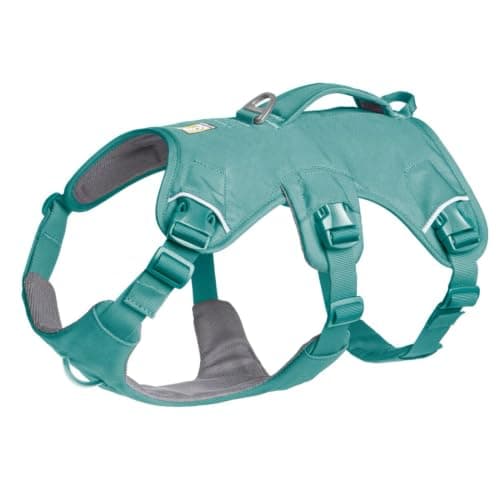
Two mechanisms suit a sighthound, and the pick depends on your dog. A martingale harness like the 2 Hounds Freedom is the natural fit for the breed, because it works on the same self-cinching principle Greyhound owners already trust in a collar: when the dog surges the loop tightens instead of opening, fighting the exact backward motion an escaper uses, while its front ring redirects a pull. A three-strap harness like the Ruffwear Web Mastertakes the other route: a strap behind the ribcage closes the shape a dog reverses through, and its padded top handle gives you close control at a trigger — it is foam-lined and genuinely hard to escape when snug, our overall pick for a determined escaper. Our Web Master vs Freedom comparison lays out which mechanism suits which dog; if the self-cinching principle is new to you, our explainer on how a martingale harness works shows why the loop tightens on a surge rather than gaping open. One honest size caveat: for a small sighthound — an Italian Greyhound or a Whippet — the Gooby Escape Free is built around small-dog escape geometry with an extra rear strap. But it is designed for small breeds and will not fit a standard, full-size Greyhound; do not size it up in hopes it will stretch, because for a racing-size sighthound the Web Master or the Freedom is the pick.
Snug is the whole game — and the collar backup
On a sighthound, fit is not a detail; it is the entire mechanism. The strap has to be genuinely snug — two fingers under it and no more — and because a Greyhound is thin-skinned with almost no fat padding, you want a design that spreads pressure rather than digging a narrow band into the body. Measure the chest at its widest and the neck separately, buy to the chart, and re-check the fit often, since a lean dog’s condition and coat change through the year. Our harness sizing guide walks the two-finger check step by step. For a dog that has slipped free before, run the belt-and-braces setup: your leash to the harness and a short backup connection to a well-fitted martingale collar, so a slipped harness never becomes a loose sighthound near traffic. If your Greyhound sits at the larger or the mid-size end and you want the same mechanisms sized differently, our large-dog and medium-dog escape picks cover the same designs across builds. Whichever design you land on, introduce it slowly and pair the first few walks with treats, because a thin-skinned, sensitive dog that has a bad first experience with a harness can become genuinely hard to gear up at all. A calm, well-fitted harness the dog steps into willingly is worth far more on a sighthound than a maximally secure one it braces and fights every single time.