LEASH LOAM

Best Escape-Proof Harnesses for Rescue Dogs

A newly-adopted dog is a flight risk — frightened, unsure of you, and looking for a gap the moment something spooks it. These are the escape-proof harnesses that close that gap while a rescue dog learns it's safe.

By Stephen V.Last verified How we pick

The most dangerous window in a rescue dog’s life is the first few weeks. A newly-adopted dog doesn’t yet know you, its home, or that it’s safe — so it’s primed for flight, and a startle it would shrug off in a year can send it ducking, spinning and backing out of a loose harness to bolt. Shelters and rescues call the worst version of this the “freeze, fight, flight” new-dog risk, and a bolted rescue dog in an unfamiliar neighborhood is a genuine emergency. The gear job is simple to state and vital to get right: a harness the dog physically cannot reverse out of, worn from the very first walk.

We rank these on the security mechanism first— a third strap behind the ribcage or a martingale loop that cinches on a surge closes the gap a two-strap harness leaves — then on a handle for close control and a fit for the dog in front of you. Two rules apply to every rescue, whatever you buy: fit it snug (two fingers under a strap, no more), and always run a short backup leash to a well-fitted collar, so a slip on one connection never means a loose dog. We haven’t hand-tested these; we read the published specs and reasoned from how each strap layout resists a frightened dog’s escape.

How this is funded:we earn a commission if you buy through our links, at no extra cost to you. It never changes which product we recommend, and we’ll tell you plainly when we’d skip one. Full disclosure.

Quick picks

Ranked on design, published specs and buyer fit. Select a row to jump to the full write-up. We have not hand-tested these — here is exactly what we do instead.

#ProductBest forPrice
1
Ruffwear Web Master Harness

Ruffwear Web Master Harness

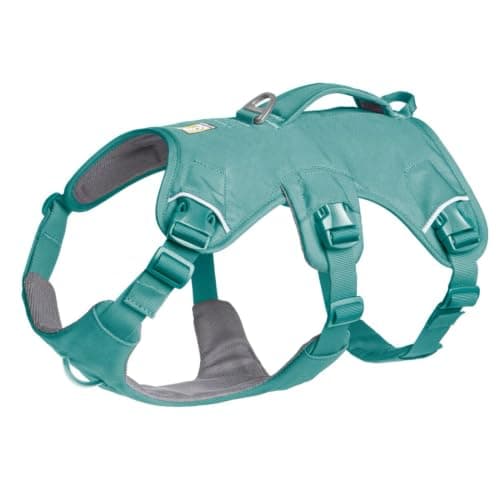
The harness to buy when your dog backs out of everything else. A third strap behind the ribcage closes the gap a two-strap harness leaves, so there is no shape for the dog to reverse out of — and a padded top handle lets you hold on or lift.

Best overall
$79.99 · View on Amazon

Price as of August 5, 2026. #ad How we’re funded

2
2 Hounds Design Freedom No-Pull Harness

2 Hounds Design Freedom No-Pull Harness

For the dog that pulls AND backs out, the Freedom's martingale loop is the trick: when the dog surges the harness snugs down rather than opening up, so it fights the very motion an escaper uses. Not a three-strap fortress, but far harder to reverse out of than a plain vest.

Best for a rescue that pulls and bolts
$34.98 · View on Amazon

Price as of August 5, 2026. #ad How we’re funded

3
Gooby Escape Free Sport Harness

Gooby Escape Free Sport Harness

Built specifically for the small dog that slips its harness the moment it panics. The extra rear strap and snug vest shape are designed around a toy dog's ability to spin and reverse out — the small-breed answer to the Web Master.

Best for a small rescue
$28.45 · View on Amazon

$33.7516% off

Price as of August 5, 2026. #ad How we’re funded

The picks in full

#1Best overall

Ruffwear Web Master Harness

The harness to buy when your dog backs out of everything else. A third strap behind the ribcage closes the gap a two-strap harness leaves, so there is no shape for the dog to reverse out of — and a padded top handle lets you hold on or lift.

Strengths

  • Three straps instead of two — removes the loop a dog backs out through
  • Padded top handle for close control or lifting over obstacles
  • Foam-lined, secure, and genuinely hard to escape when fitted snugly

Trade-offs

  • Back-clip focused — it is a security harness, not a dedicated no-pull tool
  • Premium price, and overkill for a dog that has never escaped
Type3-strap escape-proof harness with handle
AttachmentBack (aluminum V-ring) + reinforced front loop
FitsXXS–XL · sized by girth
MaterialFoam-lined nylon, three-strap body
Escape securityThird strap behind the ribs closes the escape gap
Best forAll sizes; the go-to for determined escapers

Specs read from the product listing, on July 22, 2026. “Not published” means the brand does not state that figure.

#2Best for a rescue that pulls and bolts

2 Hounds Design Freedom No-Pull Harness

For the dog that pulls AND backs out, the Freedom's martingale loop is the trick: when the dog surges the harness snugs down rather than opening up, so it fights the very motion an escaper uses. Not a three-strap fortress, but far harder to reverse out of than a plain vest.

Strengths

  • Martingale action tightens on a surge instead of loosening
  • Velvet-lined belly strap keeps it comfortable when snug
  • Doubles as one of the best no-pull harnesses you can buy

Trade-offs

  • Not a dedicated three-strap escape harness like the Web Master
  • A committed Houdini can still work a two-strap design given time
TypeMartingale no-pull harness (escape-resistant)
AttachmentFront (chest) & back (martingale loop)
FitsXS–XL · sized by chest girth
MaterialNylon webbing, velvet-lined belly strap
Escape securityMartingale cinches on a surge, resisting backing-out
Best forAll sizes; strong pullers who wriggle

Specs read from the product listing, on July 22, 2026. “Not published” means the brand does not state that figure.

#3Best for a small rescue

Gooby Escape Free Sport Harness

Built specifically for the small dog that slips its harness the moment it panics. The extra rear strap and snug vest shape are designed around a toy dog's ability to spin and reverse out — the small-breed answer to the Web Master.

Strengths

  • Designed around small-dog escape geometry, not scaled down from a big-dog harness
  • Extra rear strap for security without a bulky build
  • Lightweight enough for toy breeds to wear comfortably

Trade-offs

  • Aimed at small dogs — not the pick for a large, powerful escaper
  • Back-clip design; it is about security, not no-pull redirection
TypeSmall-dog escape-proof harness
AttachmentBack (D-ring)
FitsXS–L · small-breed focused
MaterialPadded mesh vest, extra rear strap
Escape securityExtra rear strap sized to small-dog escape motion
Best forSmall & toy breeds

Specs read from the product listing, on July 22, 2026. “Not published” means the brand does not state that figure.

The three-strap harness for a flight risk

For a frightened, unpredictable dog, the Ruffwear Web Master is the harness to beat. A standard two-strap harness leaves a gap behind the front legs that a panicking dog ducks and reverses through; the Web Master adds a third strap behind the ribcage, so there’s no shape left to back out of, and its padded top handlelets you keep a bolting dog close or lift it clear of danger at the exact moment it panics. It’s foam-lined and genuinely hard to escape when fitted snug — the go-to for anxious dogs of every size that reverse out of normal harnesses. It’s a back-clip security harness first, so if your rescue also drags you down the block, read on.

When the rescue pulls as well as bolts, and the small-dog case

Many rescues pull and then panic— they surge, hit the end of the leash, spook, and reverse. For that dog the 2 Hounds Freedomis a clever answer: its back martingale loop cinches down when the dog pulls back, fighting the exact motion an escaper uses, while its front ring redirects the pulling that starts the cycle. It’s not a three-strap fortress, but for a pull-and-bolt rescue it addresses the root cause off the neck. For a small rescue— a terrier mix, a toy breed, a little dog that slips out by spinning — the Gooby Escape Free is built around small-dog escape geometry rather than scaled down from a big-dog harness, with an extra rear strap and a snug vest shape. Whichever you choose, fit is the security: measure the girth, buy to the chart, two fingers under a strap and no more, and re-check it often as a settling dog changes shape and confidence.

The double-clip safety net and the slow introduction

For a rescue, the harness is only half of a two-part safety net. The other half is a backup connection: clip the leash to the harness and a short second connection to a well-fitted collar — many escape-proof harnesses, including the Web Master, include a safety loop for exactly this — so if one fails the other still holds. Use a fixed leash, never a retractable, keep early walks short and quiet in low-traffic places, and let the dog decompress. And introduce the harness slowly: a scared new dog can be frightened of the harness itself, so our guide to getting a dog used to a harness and our guide to stopping a dog backing outboth matter here. Above all, a rescue’s first weeks are about safety and trust — the gear buys you the time for the dog to learn it’s home. For more strong-dog security options, see our escape-proof picks for large dogs.

Keep a new dog safe

Frequently asked questions

What's the best escape-proof harness for a new rescue dog?

The Ruffwear Web Master: a three-strap security harness that closes the gap a frightened dog backs out through, with a padded handle for close control when a new dog panics. For a rescue that pulls and then bolts, the 2 Hounds Freedom's martingale resists the backing-out motion; for a small rescue, the Gooby Escape Free is built around small-dog escape geometry. Whatever you buy, fit it snug and add a backup collar connection.

Why are newly-adopted dogs such a flight risk?

Because a new dog doesn't yet know you, its home, or that it's safe, so it's primed for flight — a startle it would ignore later can send it bolting in the first weeks. Rescues describe the early period as a decompression window. Manage it with an escape-proof harness worn from the first walk, a backup collar connection, a fixed (never retractable) leash, and short, quiet outings in low-traffic places.

Should I use two connection points on a rescue dog?

Yes — it's the single most important rule for a flight risk. Clip the leash to a well-fitted escape-proof harness and run a short backup connection to a properly-fitted collar, so a slip on one never becomes a loose dog. Many escape-proof harnesses, including the Web Master, include a safety loop for this. It's cheap insurance during the weeks a new dog is most likely to bolt.

My rescue is scared of the harness itself — what do I do?

Go slow. A frightened new dog can associate the harness with being grabbed, so pairing it with food and taking days rather than minutes to introduce it prevents a fight at harness time. Our guide to getting a dog used to a harness lays out the treat-first steps. In the meantime, if the dog will tolerate any secure setup, prioritize safety — an escape-proof harness plus a backup collar — while you build the positive association.

Sources

Keep reading