The three-strap fortress
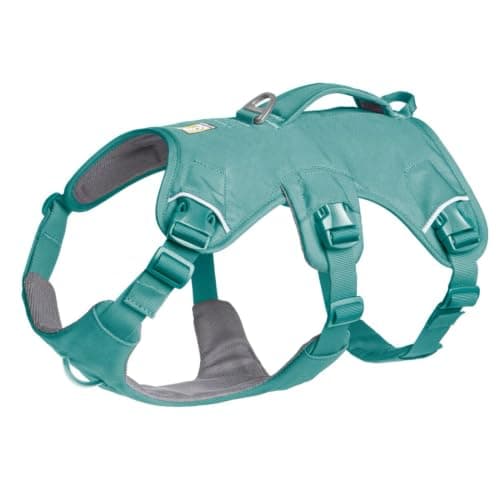
Our top pick is the Ruffwear Web Master, because its security doesn’t rely on the dog holding still. A third strap behind the ribcage closes the shape a Shepherd reverses through, so a sudden spin-and-bolt has nowhere to go, and the padded top handle lets you take close control the instant your dog fixes on a trigger. It’s foam-lined and genuinely hard to escape when snug. The honest caveats: it’s back-clip focused, so it’s a security harness rather than a dedicated no-pull tool, and it’s a premium price that’s overkill for a placid dog that has never escaped. For a reactive Shepherd that bolts when startled, though, three straps plus a snug fit is the most secure design here.
The martingale, and hardware for a strong dog
Because most German Shepherds pull as well as bolt, the 2 Hounds Freedom is often the smarter all-rounder: its back martingale loop cinches on a surgerather than opening up — fighting the reverse motion an escaper uses — while the front chest ring redirects the everyday pull. It’s sized by exact chest girth for a precise, slower-to-creep fit, and it’s one of the best no-pull harnesses you can buy; our Web Master vs Freedom comparisonweighs the two mechanisms. It isn’t a three-strap fortress, so a truly relentless escaper may still want the Web Master. For a Shepherd that’s exceptionally strong and hard on gear, the Kurgo Tru-Fit brings a steel nesting buckleand five adjustment points — the toughest hardware here — plus a car tether, with the caveat that its security is a snug five-point fit rather than a dedicated escape strap, and its crash rating is brand-tested to FMVSS 213, not independently CPS-certified.
Snug is the whole game — and so is the backup
On a Shepherd, fit decides whether the harness holdswhen the dog panics. Measure the chest girth at the widest point behind the front legs and buy to the brand’s chart — a Shepherd’s coat can hide a loose fit — then set it so you can slide two flat fingers under any strap and no more. Re-check it every walk, because a strong puller creeps a fit looser as it goes. Our harness sizing guide covers the two-finger check, and our guide to a dog backing out explains the designs in depth. For a dog that has slipped free before, run the belt-and-braces setup: your leash to the harness anda short backup connection to a well-fitted collar, so a slipped harness never becomes a loose, powerful dog near a road. And remember that for a reactive Shepherd the harness only manages the moment — distance from triggers and reward-based counter-conditioning are what actually reduce the bolting, which our reactive-gear guide for the breed covers alongside a qualified trainer.