The three-strap fortress
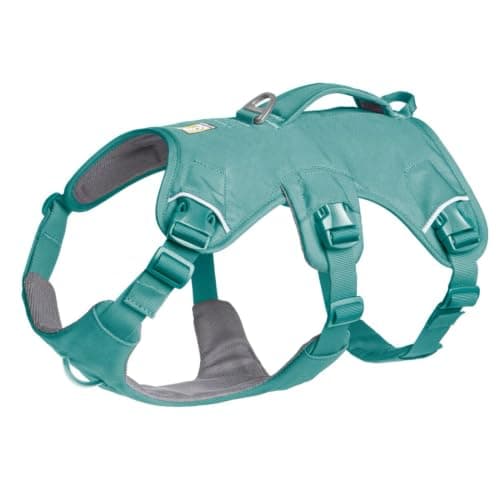
Our top pick for a pit bull-type dog is the Ruffwear Web Master: a third strap sits behind the ribcage, so there’s no loose loop for the dog to back out through — you remove the escape shape rather than just tightening it. It’s foam-lined and genuinely hard to escape when fitted snugly, and its padded top handle gives you close control the instant the dog spots a trigger or braces to reverse. The honest caveats: it’s back-clip focused, so it’s a security harness rather than a dedicated no-pull tool, and it’s a premium price that’s overkill for a dog that has never escaped. For a committed pit bull escaper, though, three straps and a snug fit is the most secure design here.
The martingale, and hardware for a strong dog
If your dog pulls hard and backs out, the 2 Hounds Freedom is the martingale answer: when the dog surges, the back loop cinches down instead of opening up, fighting the exact reverse motion an escaper uses, while the front chest ring redirects the pull. It’s sized by exact chest girth for a precise fit, and it doubles as one of the best no-pull harnesses you can buy — our Web Master vs Freedom comparisonlays out which mechanism suits which dog. It isn’t a three-strap fortress, so a truly relentless Houdini may still want the Web Master. For a dog that’s exceptionally strong and hard on gear, the Kurgo Tru-Fit brings a steel nesting buckleand five adjustment points — the toughest hardware here — plus a car seat-belt tether, though note its security comes from a snug five-point fit rather than a dedicated escape strap, and its crash rating is brand-tested to FMVSS 213, not independently CPS-certified.
Snug is the whole game
On a pit bull, fit decides whether the harness holds. A brilliant three-strap design worn loose still leaves a gap a strong dog will find, and a neck near the width of the head gives an escaper a real chance. Measure the chest girth at the widest point behind the front legs and buy to the brand’s chart; once it’s on, you should just slide two flat fingers under any strap — snug enough that a hard backward plant can’t pull it over the shoulders. Re-check it every walk, because a strong dog works a fit looser over time. Our harness sizing guide covers the two-finger check, and our guide to a dog backing out explains the fit and the designs in depth. For a dog that has slipped free before, run a backup: your leash to the harness anda short secondary connection to a well-fitted collar, so a slipped harness never becomes a loose, powerful dog near traffic. And introduce any new harness slowly with treats — a confident dog that steps into its gear willingly is easier to keep secure than one that braces and fights it.