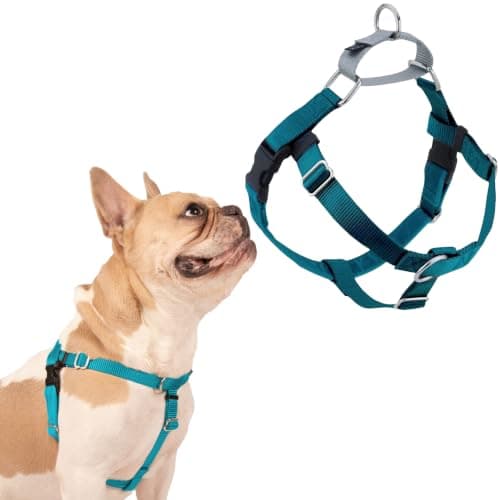
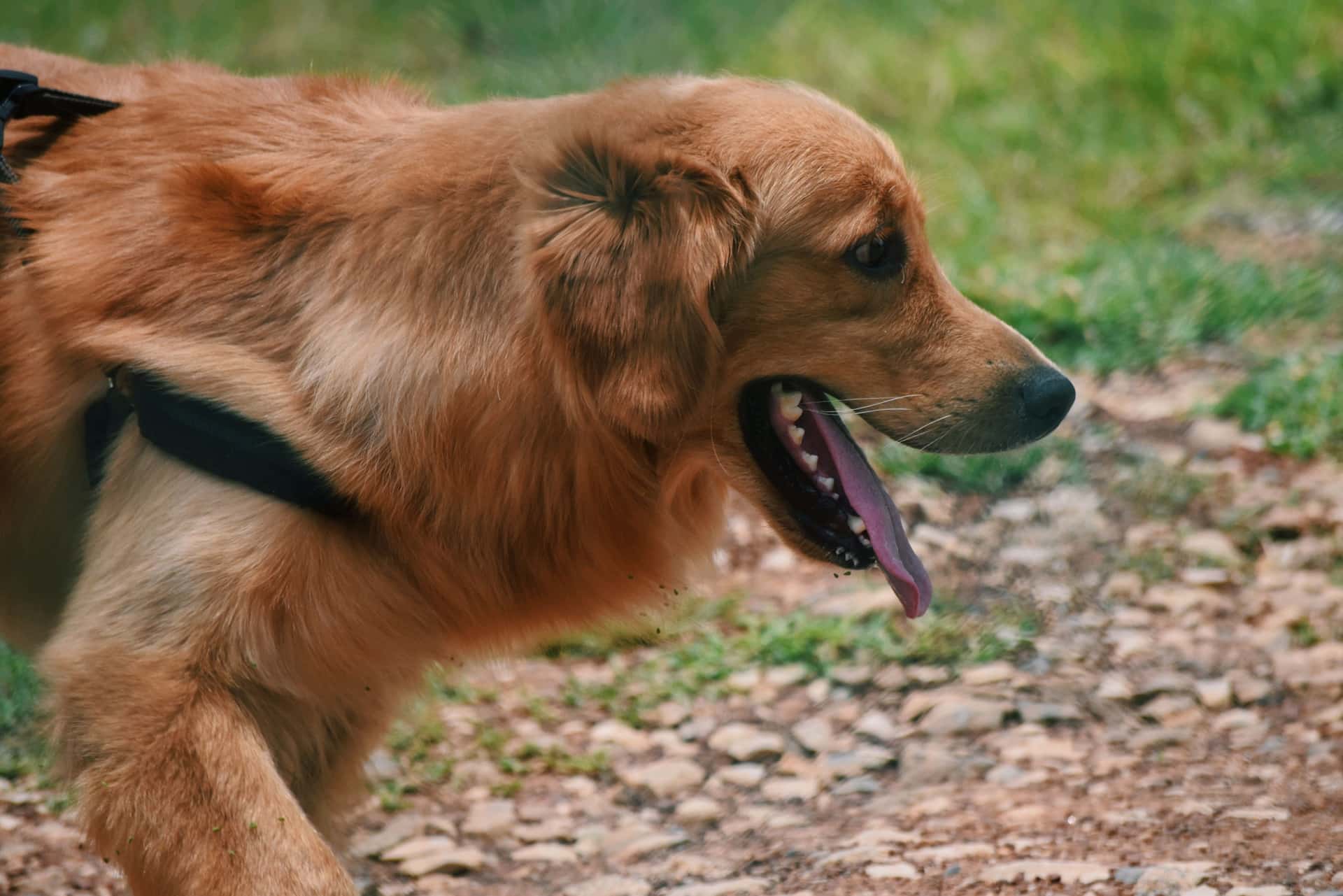
A barrel ribcage above a narrow waist is the shape that makes a harness rotate and ride toward the throat. These are the multi-point designs that lock onto a deep chest and stay where you put them.
The Kurgo Enhanced Strength Tru-Fit is the pick for a deep chest — it publishes five adjustment points and a steel nesting buckle, and on this body shape the number of independent straps is the whole ballgame: five places to tighten means the harness can be shaped to a wide ribcage and a narrow waist instead of splitting the difference. It suits a strong, broad dog whose owner also drives with it. The budget pick is the rabbitgoo No-Pull: the cheapest harness here with four adjustment points and a padded chest panel, which is enough for a moderate puller with a deep chest.
Here is the specific problem, because almost every page on the internet about barrel-chested dogs skips it. A harness stays put by being wedged: the chest piece sits in front of the shoulders, the girth strap sits behind them, and the ribcage between them is wider than either, so the harness cannot slide. On a deep-chested dog — Boxer, Greyhound, Doberman, Weimaraner, Setter, and a huge number of mixes — the geometry changes. The ribcage is deep front-to-back and the waist tucks up sharply behind it, so the girth strap sits on a narrowing cone. Pull forward and the whole harness wants to slide forward and up, toward the narrowest point of all: the throat. That is the rotation people describe, and it is a shape problem rather than a quality problem.
Which is why two-strap harnesses with a single sliding chest adjustment struggle most here, and why we weight adjustment pointsabove brand, padding and price on this page. A harness with four or five independent buckles can be set tight at the chest, snug at the sternum and firm behind the ribs; a harness with one sliding strap can only be set tight enough to be uncomfortable or loose enough to rotate. Fit is also the half of this you control — our sizing guide has the measurements and the two-finger test.
How this is funded:we earn a commission if you buy through our links, at no extra cost to you. It never changes which product we recommend, and we’ll tell you plainly when we’d skip one. Full disclosure.
Quick picks
Ranked on design, published specs and buyer fit. Select a row to jump to the full write-up. We have not hand-tested these — here is exactly what we do instead.
#
Product
Best for
Price
1
Kurgo Enhanced Strength Tru-Fit Harness
A rare crossover: a strong five-point harness with a front no-pull ring for walks AND a steel nesting buckle plus a seat-belt tether for the car. Kurgo crash-tested it themselves to FMVSS 213 — a real test, but not the same as an independent CPS certification.
The everyday harness to buy if your dog is active: a padded vest with a reinforced front chest clip for no-pull walks and an aluminum back V-ring for relaxed ones. Not the cheapest, but the build quality is the reason people replace it with the same thing.
The most complete no-pull design here: two attachment points plus a patented martingale loop on the back that gently tightens when the dog surges, so it redirects without choking. Pair it with a double-ended leash and it does more than a plain front-clip.
The best cheap no-pull harness: a padded vest with both a front and back clip and a top control handle, for a fraction of the premium brands. It won't last as long as a Ruffwear, but it does the same two jobs on day one.
A rare crossover: a strong five-point harness with a front no-pull ring for walks AND a steel nesting buckle plus a seat-belt tether for the car. Kurgo crash-tested it themselves to FMVSS 213 — a real test, but not the same as an independent CPS certification.
Strengths
+Front-clip no-pull ring for walks, plus a car seat-belt tether included
+Five adjustment points and a steel nesting buckle for strong dogs
+Manufacturer crash-tested to the FMVSS 213 child-restraint standard
Trade-offs
−Crash-tested by the brand, not certified by the independent Center for Pet Safety
−Heavier and fiddlier to fit than a simple walking harness
Type
Dual-purpose no-pull + car harness
Attachment
Front (chest) & back (D-ring)
Fits
XS–XL
Material
Nylon webbing, steel nesting buckle
Crash test
Brand crash-tested (FMVSS 213, Calspan, dogs to 75 lb) — not CPS-certified
Best for
Medium–large, strong dogs
Specs read from the product listing, on July 22, 2026. “Not published” means the brand does not state that figure.
#2Best padded fit that holds position
Ruffwear Front Range Harness
The everyday harness to buy if your dog is active: a padded vest with a reinforced front chest clip for no-pull walks and an aluminum back V-ring for relaxed ones. Not the cheapest, but the build quality is the reason people replace it with the same thing.
Strengths
+Front and back clips — no-pull when you need it, back-clip when you don't
+Padded, foam-lined chest and belly panels spread pressure comfortably
+Four adjustment points and reflective trim; genuinely hard-wearing
Trade-offs
−Priced well above budget harnesses
−The front clip helps but this is a comfort harness first, not a dedicated anti-pull tool
Type
Everyday dual-clip padded harness
Attachment
Front (chest) & back (aluminum V-ring)
Fits
XXS–XL · sized by girth
Material
Padded nylon, foam-lined panels, reflective trim
Best for
All sizes; a favorite for active medium–large dogs
Specs read from the product listing, on July 22, 2026. “Not published” means the brand does not state that figure.
#3Best for a deep-chested puller
2 Hounds Design Freedom No-Pull Harness
The most complete no-pull design here: two attachment points plus a patented martingale loop on the back that gently tightens when the dog surges, so it redirects without choking. Pair it with a double-ended leash and it does more than a plain front-clip.
Strengths
+Front chest ring AND a back martingale loop — two ways to redirect one pull
+Velvet-lined belly strap reduces the chafing that stops most dogs escaping mid-walk
+Sized by exact chest girth, so the fit is precise rather than S/M/L guesswork
Trade-offs
−Costs more than a basic front-clip harness
−Gets the most out of a double-ended leash, which is an extra purchase
Type
Dual-clip no-pull harness with martingale
Attachment
Front (chest) & back (martingale loop)
Fits
XS–XL · sized by chest girth
Material
Nylon webbing, velvet-lined belly strap
Escape security
Martingale loop cinches gently on a surge
Best for
All sizes, especially strong pullers
Specs read from the product listing, on July 22, 2026. “Not published” means the brand does not state that figure.
#4Budget pick
rabbitgoo No-Pull Dog Harness
The best cheap no-pull harness: a padded vest with both a front and back clip and a top control handle, for a fraction of the premium brands. It won't last as long as a Ruffwear, but it does the same two jobs on day one.
Strengths
+Front and back clips plus a grab handle at a budget price
+Four adjustment straps and a padded vest for an easy fit
+Reflective stitching for low-light walks
Trade-offs
−Buckles and webbing aren't as durable as premium harnesses
−Strong, determined pullers can work the fit loose over time
Type
Budget dual-clip padded harness
Attachment
Front (chest) & back (D-ring)
Fits
S–XL · adjustable, sized by girth
Material
Padded nylon oxford, reflective stitching
Best for
All sizes; check the girth chart for toy breeds
Specs read from the product listing, on July 22, 2026. “Not published” means the brand does not state that figure.
What to look for, in order of how much it matters
Independent adjustment points — four minimum, five better. This is the one feature that decides whether a harness fits a deep chest. The Kurgo publishes five; the Front Range publishes four.
Sizing by measured girth, not S/M/L. A deep-chested dog is almost always between two letter sizes, because the chart assumes a proportional dog. The 2 Hounds Freedomis sized by exact chest girth, which removes the guess entirely — the single best feature on this body shape after adjustment count.
A wide, padded chest panel rather than a thin strap.Width spreads load over more of the breastbone and resists twisting; a narrow strap acts like a hinge. This is the Front Range’s strength.
A front clip that sits low and central. On a deep chest, a front ring mounted high rides up into the throat on the first pull. Lower and more central keeps the redirection where it should be.
Hardware you can trust under load. Deep-chested dogs are often powerful dogs. A steel nesting buckle is not marketing on a 90 lb dog that hits the end of the leash.
Why the shape and the pulling interact
A deep-chested dog is mechanically well set up to pull: the chest is where its strength is, and a back-clip harness lets it lean into the weight exactly like a sled dog. That makes the front clip more important here, not less — moving the ring to the chest turns the pull into a turn, and our front-clip roundup explains the mechanism in full. But the front ring only works if the harness holds its position, which brings you straight back to adjustment points. A rotating front clip is worse than a back clip, because it ends up loading the throat.
For a genuinely hard puller with this build, the 2 Hounds Freedom is the one we would buy over the Kurgo: the back martingale loop cinches gently on a surge, so the harness is self-tightening at exactly the moment a deep chest wants to slide forward. Pair it with a double-ended leash and you get two points of contact, which spreads the load instead of concentrating it on one strap. Our strong-puller roundup covers the heavy end of this.
Two deep-chested cases that need something different
Sighthounds. A Greyhound or Whippet has a deep chest and a neck as wide as its head, so it can reverse out of a normal harness as well as rotate one. Go to escape-proof harnesses for greyhounds— the problem there is escape, not steering.
Brachycephalic barrel chests.A Bulldog, Frenchie or Pug has the deep chest with no neck to speak of and a compromised airway, so anything that can slide toward the throat is a real risk rather than a nuisance. Those dogs need a well-padded Y-front vest and a scrupulous fit — see harnesses for bulldogs, for French Bulldogs, and Y-shaped vs H-shaped harnesses for why the front geometry matters so much on that build. If your dog is a Boxer specifically, our Boxer roundupnarrows these same picks to that breed’s springy pull style.
A deep chest, a tucked waist and thin skin over hard muscle — the no-pull harnesses that fit a sighthound's odd shape, clear the deep chest and won't chafe.
A Y-front sits on the breastbone and leaves the shoulders free; a straight front strap can cross the shoulder joint. What the harness shape means for your dog's gait.
What kind of harness is best for a barrel-chested dog?+
One with four or five independent adjustment points rather than a single sliding chest strap. A deep ribcage above a narrow waist lets a two-strap harness slide forward and up toward the throat on every pull; more buckles let you set the chest, sternum and girth separately so the harness cannot rotate. The Kurgo Tru-Fit publishes five.
Why does my dog's harness keep sliding forward toward his neck?+
Because the girth strap is sitting on a narrowing part of the body. On a deep-chested dog the waist tucks up sharply behind the ribcage, so the strap slides toward the wider chest and then toward the throat. Tighten to a two-finger fit first; if it still creeps, the harness has too few adjustment points for this body shape.
Should I size up or down for a deep-chested dog?+
Neither — measure. Deep-chested dogs usually land between two letter sizes because size charts assume proportional dogs. Measure the girth just behind the front legs and use the brand's chart, and where a harness is sized by exact girth rather than S/M/L — the 2 Hounds Freedom is — take that option, because it removes the guess.
Is a front-clip harness safe for a deep-chested dog?+
Yes, and it is the clip position we recommend, provided the harness holds its position. A front ring redirects a pull into a turn instead of letting the dog lean into it. The risk is a harness that rotates, because then the front strap ends up loading the throat — which is an argument for more adjustment points, not for a back clip.