What the extra twenty dollars actually buys
If you have already read our under-$30 roundup, the honest question is whether stretching to this band changes anything. It changes exactly two things.
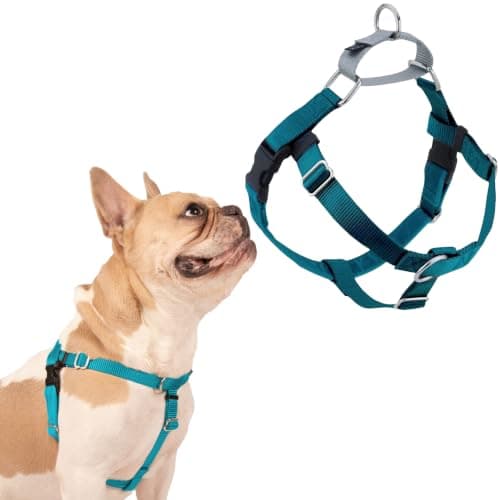
The first is a second point of contact. A plain front-clip harness has one ring on the chest; when the dog surges, that ring rotates the shoulders back toward you and the pull stops working. The 2 Hounds Freedom adds a martingale loop across the back that draws gently closed on the same surge, so the dog feels a consistent, low-force cue from two places at once. Clip a double-ended leash to both and you have steering rather than braking. Nothing under thirty dollars offers that.
The second is hardware that does not become the weak link. The Kurgo Tru-Fit uses a steel nesting buckle rather than a plastic side-release, which matters if your dog is the kind that hits the end of the leash at a dead run. It is also the only pick here with a crash-tested claim, so it covers the drive to the trailhead as well as the walk — see car-and-walks harnesses for how far that doubling-up genuinely goes.
How to choose between these four
- Your dog pulls hard and you want the most control available: 2 Hounds Freedom, with a double-ended leash.
- Your dog is strong, broad or hard on gear, or also rides in the car: Kurgo Tru-Fit.
- You want the least complicated thing that works, today: PetSafe Easy Walk. One ring, two buckles, nothing to learn.
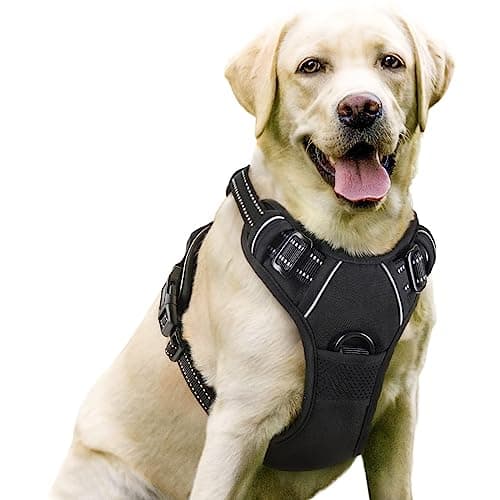
- You want to spend the least: rabbitgoo. A padded vest with a front clip, a back clip and a handle for a fraction of the band.
The one thing a price band cannot buy
Fit. A fifty-dollar harness fitted loose controls a dog worse than a twenty-dollar one fitted properly, and the most common reason people conclude “no-pull harnesses don’t work” is a chest strap sitting two inches too low or too slack. Measure the girth behind the front legs before you buy, use the brand’s chart rather than its S/M/L label, and tighten to a two-finger fit — our sizing guide walks through it, and no-pull harness not working covers the fixes in order. A harness also manages pulling rather than curing it; the cure is reward-based loose-leash training, and the harness is what makes today’s walk survivable while that work happens.
Two cases send you out of this band entirely. If your dog backs out of its harness and bolts, control is not the problem and you want an escape-proof design — there are options under fifty dollars there too. If it barks and lunges at other dogs or people, start with reactive-dog gear, where a head halter often beats any harness at this price.