LEASH LOAM

Best Dog Training Harnesses for Loose-Leash Work

A training harness has one job: make a reward-based loose-leash session possible today. Ranked on two attachment points, zero correction, and a fit that holds across twenty reps.

By Stephen V.Last verified How we pick

The 2 Hounds Design Freedom is the training harness to buy — it is the only harness we rank with a front chest ring and a back martingale loop, which means a double-ended leash can steer a dog rather than just brake it, and that is the difference between a session you can run and a session that becomes a tug-of-war. It is the pick for an owner actively doing loose-leash work with a dog that already pulls hard. If you want to start this week for as little as possible, the rabbitgoo No-Pull is the budget pick: the cheapest harness here that still gives you a real front ring, a back ring and a padded vest, which is the whole mechanical requirement. Between them sit the Ruffwear Front Range (the one to buy if your sessions run long and your dog is in it for hours) and the PetSafe Easy Walk (one ring, two buckles, nothing to learn).

Prices come from the live listings and are stamped as of November 22, 2026. Nothing on this page hard-codes a price, so it cannot go quietly stale.

What a training harness has to do

“Training harness” is a shop label, not a product category, and plenty of harnesses sold under it are ordinary back-clip vests. Three things make a harness genuinely useful while you are teaching a dog to walk on a loose leash.

  • Two places to clip. One line to the chest and one to the back turns braking into steering: you can ask for a turn before the dog reaches the end of the leash, which is when the reward-based work actually happens.
  • No correction built in. You are reshaping a behavior, so the gear must not punish the dog for performing it. The AVSAB’s humane-training position statement recommends reward-based methods; a harness that tightens on the throat works against the method you are using.
  • A fit that holds across twenty reps. A training session is a stop-start loop — dog surges, you stop, dog returns, you reward, repeat. Every one of those is a chance for a chest strap to slide out of position, and a harness that has rotated by rep ten is teaching nothing.

How this is funded:we earn a commission if you buy through our links, at no extra cost to you. It never changes which product we recommend, and we’ll tell you plainly when we’d skip one. Full disclosure.

Quick picks

Ranked on design, published specs and buyer fit. Select a row to jump to the full write-up. We have not hand-tested these — here is exactly what we do instead.

#ProductBest forPrice
1
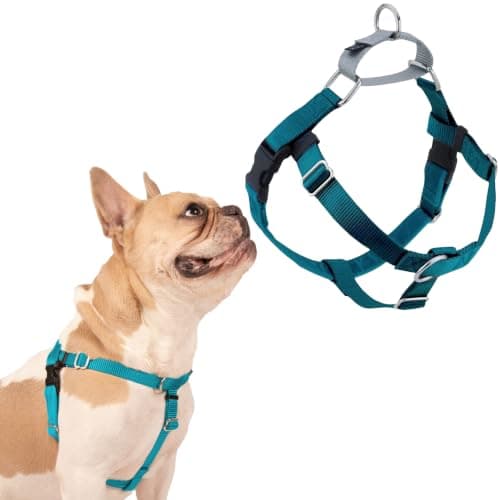
2 Hounds Design Freedom No-Pull Harness

2 Hounds Design Freedom No-Pull Harness

The most complete no-pull design here: two attachment points plus a patented martingale loop on the back that gently tightens when the dog surges, so it redirects without choking. Pair it with a double-ended leash and it does more than a plain front-clip.

Best overall: two points to steer from
$34.98 · View on Amazon

Price as of November 22, 2026. #ad How we’re funded

2
Ruffwear Front Range Harness

Ruffwear Front Range Harness

The everyday harness to buy if your dog is active: a padded vest with a reinforced front chest clip for no-pull walks and an aluminum back V-ring for relaxed ones. Not the cheapest, but the build quality is the reason people replace it with the same thing.

Best for long or daily sessions
$59.99 · View on Amazon

Price as of November 22, 2026. #ad How we’re funded

3
PetSafe Easy Walk Harness

PetSafe Easy Walk Harness

The simplest front-clip harness that works: the leash clips to a martingale ring on the chest, so a pull turns the dog back toward you instead of letting it lean into the weight. Cheap, everywhere, and easy to fit — the honest starting point.

Simplest to fit and start with
$22.99 · View on Amazon

Price as of November 22, 2026. #ad How we’re funded

4
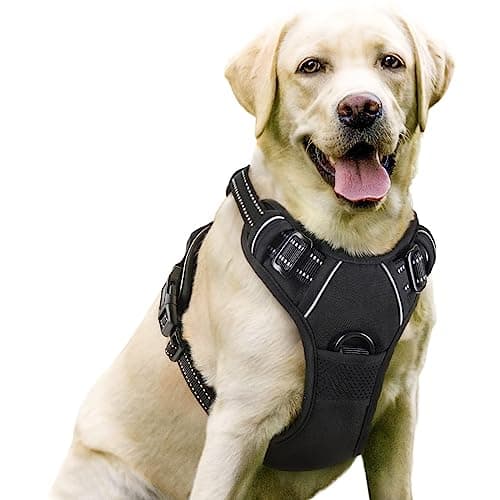
rabbitgoo No-Pull Dog Harness

rabbitgoo No-Pull Dog Harness

The best cheap no-pull harness: a padded vest with both a front and back clip and a top control handle, for a fraction of the premium brands. It won't last as long as a Ruffwear, but it does the same two jobs on day one.

Budget pick: cheapest with both rings
$15.16 · View on Amazon

$20.9828% off

Price as of November 22, 2026. #ad How we’re funded

The picks in full

#1Best overall: two points to steer from

2 Hounds Design Freedom No-Pull Harness

The most complete no-pull design here: two attachment points plus a patented martingale loop on the back that gently tightens when the dog surges, so it redirects without choking. Pair it with a double-ended leash and it does more than a plain front-clip.

Strengths

  • Front chest ring AND a back martingale loop — two ways to redirect one pull
  • Velvet-lined belly strap reduces the chafing that stops most dogs escaping mid-walk
  • Sized by exact chest girth, so the fit is precise rather than S/M/L guesswork

Trade-offs

  • Costs more than a basic front-clip harness
  • Gets the most out of a double-ended leash, which is an extra purchase
TypeDual-clip no-pull harness with martingale
AttachmentFront (chest) & back (martingale loop)
FitsXS–XL · sized by chest girth
MaterialNylon webbing, velvet-lined belly strap
Escape securityMartingale loop cinches gently on a surge
Best forAll sizes, especially strong pullers

Specs read from the product listing, on July 22, 2026. “Not published” means the brand does not state that figure.

#2Best for long or daily sessions

Ruffwear Front Range Harness

The everyday harness to buy if your dog is active: a padded vest with a reinforced front chest clip for no-pull walks and an aluminum back V-ring for relaxed ones. Not the cheapest, but the build quality is the reason people replace it with the same thing.

Strengths

  • Front and back clips — no-pull when you need it, back-clip when you don't
  • Padded, foam-lined chest and belly panels spread pressure comfortably
  • Four adjustment points and reflective trim; genuinely hard-wearing

Trade-offs

  • Priced well above budget harnesses
  • The front clip helps but this is a comfort harness first, not a dedicated anti-pull tool
TypeEveryday dual-clip padded harness
AttachmentFront (chest) & back (aluminum V-ring)
FitsXXS–XL · sized by girth
MaterialPadded nylon, foam-lined panels, reflective trim
Best forAll sizes; a favorite for active medium–large dogs

Specs read from the product listing, on July 22, 2026. “Not published” means the brand does not state that figure.

#3Simplest to fit and start with

PetSafe Easy Walk Harness

The simplest front-clip harness that works: the leash clips to a martingale ring on the chest, so a pull turns the dog back toward you instead of letting it lean into the weight. Cheap, everywhere, and easy to fit — the honest starting point.

Strengths

  • Front chest ring redirects pulling with no training curve
  • Inexpensive and stocked almost everywhere
  • Quick-snap shoulder and belly buckles make it fast to put on

Trade-offs

  • Sits across the shoulders, which can loosen and rotate on deep-chested dogs
  • Back has no attachment point — it is a front-clip-only tool
TypeFront-clip no-pull harness (chest ring)
AttachmentFront (chest martingale ring)
FitsPetite–XL
MaterialNylon webbing
Best forAll sizes; best on average-build dogs

Specs read from the product listing, on July 22, 2026. “Not published” means the brand does not state that figure.

#4Budget pick: cheapest with both rings

rabbitgoo No-Pull Dog Harness

The best cheap no-pull harness: a padded vest with both a front and back clip and a top control handle, for a fraction of the premium brands. It won't last as long as a Ruffwear, but it does the same two jobs on day one.

Strengths

  • Front and back clips plus a grab handle at a budget price
  • Four adjustment straps and a padded vest for an easy fit
  • Reflective stitching for low-light walks

Trade-offs

  • Buckles and webbing aren't as durable as premium harnesses
  • Strong, determined pullers can work the fit loose over time
TypeBudget dual-clip padded harness
AttachmentFront (chest) & back (D-ring)
FitsS–XL · adjustable, sized by girth
MaterialPadded nylon oxford, reflective stitching
Best forAll sizes; check the girth chart for toy breeds

Specs read from the product listing, on July 22, 2026. “Not published” means the brand does not state that figure.

The harness is half of it — the leash is the other half

This is the part most “best training harness” lists leave out. A two-point harness with a single-clip leash is a one-point harness: you have paid for a ring you cannot use. The pairing that makes a training session work is a double-ended leash clipped to both rings, so one hand can ask for a turn through the chest while the other keeps a loose, neutral line on the back. Our double-ended leash guide walks through how to hold it, and harness and leash combinations explains why we refuse to rank the boxed sets: the bundles price around the harness and throw in a single-handle nylon leash, which is the one component that does nothing for a dog that pulls.

For recall and long-line work — the other half of leash training, done in open space rather than on a sidewalk — the harness matters less and the line matters more. See training leashes for that, and how to use a long line for the method.

How to choose between these four

  • Your dog already pulls hard and you are starting training now: 2 Hounds Freedom. Two attachment points plus a martingale loop that draws gently closed on a surge, so the dog gets a consistent low-force cue from two places rather than one hard stop from one.
  • You are training daily, or your sessions run past twenty minutes: Ruffwear Front Range. Foam-lined chest and belly panels and four adjustment points, so the harness stays where you set it and the dog is comfortable for the whole session.
  • You want the least complicated thing that works, today: PetSafe Easy Walk. One chest ring, two quick-snap buckles. It has no back attachment point, so it is a front-clip-only tool and a double-ended leash has nowhere to go — a real limit, and still the right call for a first-time owner who needs this walk to be better than the last one.
  • You are training a dog you have just taken on, on a budget: rabbitgoo. A front ring, a back ring and a grab handle for a fraction of the others; it will not last as many years, and it will do this job.

Training a puppy versus retraining an adult

The gear requirement is not the same. With a puppy you are building a habit that has no competition yet, so the lightest harness that fits properly is enough and the risk you are managing is outgrowing it — our puppy harness picks and puppy leash-training guide cover that path, and can a puppy wear a harness covers the age question.

With an adult dog you are competing against a habit that has been rehearsed for years, and pulling has been working for the dog the whole time. That is where the second attachment point earns its money: you need to be able to interrupt a surge before it completes, repeatedly, without escalating. Read leash training an adult dog for the method, and why dogs pull for what you are actually competing with.

What no training harness will do

Cure the pulling. A no-pull harness manages a pull — it makes the pull stop paying, which is exactly what you want while you teach the alternative — but the dog does not learn loose-leash walking from the harness. It learns it from hundreds of paid repetitions of walking beside you, which is what the loose-leash method is for. Owners who expect the hardware to do the teaching are the ones who conclude the harness does not work; see no-pull harness not working for the fixes in the order worth trying them, starting with fit.

Two cases send you somewhere else entirely. If your dog barks and lunges at other dogs or people, the problem is arousal and distance rather than leash mechanics, and the gear that helps most is covered in reactive-dog gear. If your dog is physically stronger than you are — and plenty are — a harness may not give you enough leverage at all; read my dog is stronger than me and consider a head halter, which steers the head and takes a fraction of the force. We would not start a young puppy on one.

Fit before everything. A fifty-dollar harness fitted loose controls a dog worse than a fifteen-dollar one fitted properly, and the single most common reason a training session falls apart is a chest strap sitting two inches too low. Measure the girth behind the front legs, use the brand’s chart rather than its S/M/L label, and tighten to a two-finger fit — how to size a dog harness has the measurements, and how to put one on has the order of operations.

Keep going

Frequently asked questions

What is the best harness for training a dog not to pull?

The 2 Hounds Design Freedom, because it is the only harness we rank with both a front chest ring and a back martingale loop. Clip a double-ended leash to both and you can ask for a turn before the dog reaches the end of the line, which is where the reward-based repetitions actually happen. The rabbitgoo is the cheapest harness that still gives you both rings.

Do I need a special harness for training, or will any harness do?

Any harness that moves the leash connection to the chest will stop a pull from paying off. What a dedicated training harness adds is a second attachment point for a double-ended leash, no correction mechanism to work against reward-based methods, and enough adjustment that it does not rotate out of position across twenty stop-start reps. A plain back-clip vest gives you none of the three.

Will a training harness teach my dog to walk on a loose leash?

No — it makes the teaching possible. The harness stops pulling from working today; the dog learns loose-leash walking from hundreds of rewarded repetitions of walking beside you. Owners who expect the hardware to do the teaching are usually the ones who conclude no-pull harnesses do not work.

Is a head halter better than a training harness?

For a dog that is physically stronger than its handler, often yes: steering a dog by the head takes a fraction of the force of steering it by the chest. The trade is tolerance — many dogs need a careful, gradual introduction to a nose loop, and we would not start a young puppy on one. VCA Animal Hospitals publishes the introduction process we follow.

Sources

Keep reading