LEASH LOAM

Best Gear for a Dog That Pulls and Jumps Up

No harness stops a dog jumping — but the gear that gives you the head, or the first eighteen inches of leash, changes what happens at a greeting. Ranked honestly on that.

By Stephen V.Last verified How we pick

The PetSafe Gentle Leader is the one to buy — it is the only tool here that connects to the dog’s head, and a dog cannot launch its front feet at a stranger’s chest while its nose is being asked to turn toward yours. It is the pick for a medium or large dog that both drags you down the block and jumps on people at greetings, in the hands of an owner willing to spend two weeks introducing a nose loop properly. If you want to spend as little as possible, the rabbitgoo No-Pull is the budget pick: the cheapest harness here with a real front chest ring, which is what lets you turn the dog’s chest away from the person it is about to jump on. Between them sit the 2 Hounds Design Freedom (the best harness answer, because it redirects from two points instead of one) and the Halti Headcollar (the head halter to try if the Gentle Leader’s nose-loop fit was the problem).

Prices are pulled from the live listings and stamped as of November 22, 2026. No price is written into this page’s text.

The honest answer to “what harness stops a dog jumping?”

None of them. A harness changes where a forward pull goes; jumping up is a vertical movement powered by the back legs, and no chest strap in existence interrupts it. Any page that ranks a harness as an anti-jumping device is selling you something.

What gear can do is change the two seconds before the jump. That is worth real money, because those two seconds are where your training either happens or does not. Three mechanisms actually operate there:

  • Head control. If you have the head, you have the dog. A head halter lets you ask for the nose to turn back toward you at a fraction of the force a chest harness needs, and a dog whose head is turning cannot plant its front paws on someone.
  • Turning the chest away. A front chest ring rotates the dog’s shoulders back toward you when it leans forward. It does not stop a jump, but it means the dog arrives at the greeting sideways and slower rather than square-on and at full speed.
  • The first eighteen inches of leash. Most of the control in a greeting is leash length, not harness design. A traffic handle on the leash — a second handle low on the line — lets you shorten up with one hand without stopping, which is the single most useful thing you can do as a person approaches. See non-retractable leashes for the picks.

How this is funded:we earn a commission if you buy through our links, at no extra cost to you. It never changes which product we recommend, and we’ll tell you plainly when we’d skip one. Full disclosure.

Quick picks

Ranked on design, published specs and buyer fit. Select a row to jump to the full write-up. We have not hand-tested these — here is exactly what we do instead.

#ProductBest forPrice
1
PetSafe Gentle Leader Headcollar

PetSafe Gentle Leader Headcollar

The most control you can get without force: the loop sits around the muzzle (not the throat), so where the head goes the dog follows. For a strong, reactive dog that lunges, it's the tool that lets a smaller handler stay in charge — but it needs slow, positive introduction.

Best overall: the only tool with head control
$16.00 · View on Amazon

Price as of November 22, 2026. #ad How we’re funded

2
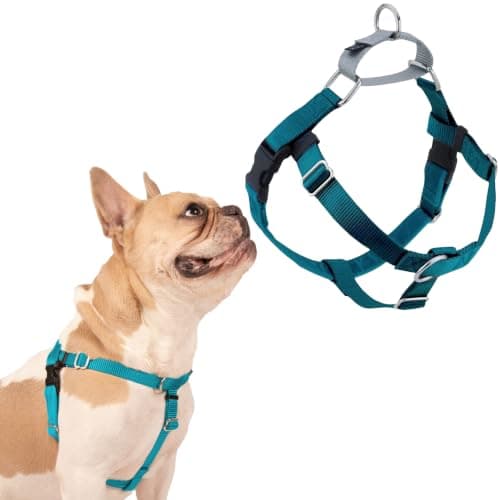
2 Hounds Design Freedom No-Pull Harness

2 Hounds Design Freedom No-Pull Harness

The most complete no-pull design here: two attachment points plus a patented martingale loop on the back that gently tightens when the dog surges, so it redirects without choking. Pair it with a double-ended leash and it does more than a plain front-clip.

Best harness: turns the chest from two points
$34.98 · View on Amazon

Price as of November 22, 2026. #ad How we’re funded

3
The Company of Animals Halti Headcollar

The Company of Animals Halti Headcollar

The main alternative to the Gentle Leader, with a padded nose band some dogs tolerate better and a safety link that clips to the collar as a backup. Same head-steering principle; the difference is fit and which one your dog will accept.

Best if the nose-loop fit was the problem
$22.94 · View on Amazon

$26.9915% off

Price as of November 22, 2026. #ad How we’re funded

4
rabbitgoo No-Pull Dog Harness

rabbitgoo No-Pull Dog Harness

The best cheap no-pull harness: a padded vest with both a front and back clip and a top control handle, for a fraction of the premium brands. It won't last as long as a Ruffwear, but it does the same two jobs on day one.

Budget pick: cheapest real front ring
$15.16 · View on Amazon

$20.9828% off

Price as of November 22, 2026. #ad How we’re funded

The picks in full

#1Best overall: the only tool with head control

PetSafe Gentle Leader Headcollar

The most control you can get without force: the loop sits around the muzzle (not the throat), so where the head goes the dog follows. For a strong, reactive dog that lunges, it's the tool that lets a smaller handler stay in charge — but it needs slow, positive introduction.

Strengths

  • Steers the head, so it redirects a lunge a body harness can't
  • Loops the muzzle, never tightens on the throat
  • Lets a lighter person manage a big, reactive dog

Trade-offs

  • Most dogs paw at it at first — it takes patient desensitization
  • Not for short-nosed (brachycephalic) breeds; PetSafe steers them to the Easy Walk harness
TypeHead halter (muzzle loop)
AttachmentUnder-chin ring
FitsPetite–Large
MaterialNylon straps, padded nose loop
Best forMedium–large lungers; not brachycephalic breeds

Specs read from the product listing, on July 22, 2026. “Not published” means the brand does not state that figure.

#2Best harness: turns the chest from two points

2 Hounds Design Freedom No-Pull Harness

The most complete no-pull design here: two attachment points plus a patented martingale loop on the back that gently tightens when the dog surges, so it redirects without choking. Pair it with a double-ended leash and it does more than a plain front-clip.

Strengths

  • Front chest ring AND a back martingale loop — two ways to redirect one pull
  • Velvet-lined belly strap reduces the chafing that stops most dogs escaping mid-walk
  • Sized by exact chest girth, so the fit is precise rather than S/M/L guesswork

Trade-offs

  • Costs more than a basic front-clip harness
  • Gets the most out of a double-ended leash, which is an extra purchase
TypeDual-clip no-pull harness with martingale
AttachmentFront (chest) & back (martingale loop)
FitsXS–XL · sized by chest girth
MaterialNylon webbing, velvet-lined belly strap
Escape securityMartingale loop cinches gently on a surge
Best forAll sizes, especially strong pullers

Specs read from the product listing, on July 22, 2026. “Not published” means the brand does not state that figure.

#3Best if the nose-loop fit was the problem

The Company of Animals Halti Headcollar

The main alternative to the Gentle Leader, with a padded nose band some dogs tolerate better and a safety link that clips to the collar as a backup. Same head-steering principle; the difference is fit and which one your dog will accept.

Strengths

  • Padded nose band is more comfortable for some dogs
  • Includes a safety link to the collar as a backup connection
  • Same head-control leverage as other halters

Trade-offs

  • Needs the same patient introduction as any head halter
  • Fit varies by muzzle shape — some dogs do better on the Gentle Leader
TypeHead halter (padded nose band)
AttachmentUnder-chin ring + collar safety link
FitsSizes 0–5
MaterialNylon straps, padded nose band
Best forMedium–large lungers; not brachycephalic breeds

Specs read from the product listing, on July 22, 2026. “Not published” means the brand does not state that figure.

#4Budget pick: cheapest real front ring

rabbitgoo No-Pull Dog Harness

The best cheap no-pull harness: a padded vest with both a front and back clip and a top control handle, for a fraction of the premium brands. It won't last as long as a Ruffwear, but it does the same two jobs on day one.

Strengths

  • Front and back clips plus a grab handle at a budget price
  • Four adjustment straps and a padded vest for an easy fit
  • Reflective stitching for low-light walks

Trade-offs

  • Buckles and webbing aren't as durable as premium harnesses
  • Strong, determined pullers can work the fit loose over time
TypeBudget dual-clip padded harness
AttachmentFront (chest) & back (D-ring)
FitsS–XL · adjustable, sized by girth
MaterialPadded nylon oxford, reflective stitching
Best forAll sizes; check the girth chart for toy breeds

Specs read from the product listing, on July 22, 2026. “Not published” means the brand does not state that figure.

Why we put a head halter above every harness here

Leverage. Steering a 70 lb dog by the chest means opposing most of its body mass with your arm; steering the same dog by the head means turning the lightest, most steerable part of it. That is why the Gentle Leader gives the most control per dollar in this whole category, and why it is the tool a handler reaches for when the dog is strong enough that a harness has stopped being enough.

The trade-off is tolerance, not performance. A nose loop is a strange sensation and plenty of dogs object to it at first, which is why VCA Animal Hospitals publishes a gradual introduction process and why we link it rather than summarising it away. Follow how to introduce a head halter before you use one on a walk, and read do head halters hurt dogs if that is the worry stopping you. A head halter is also wrong for a flat-faced breed, which has no muzzle for the loop to sit on.

How to choose between these four

  • Medium or large dog, jumps on people, pulls on the way there: PetSafe Gentle Leader, with two weeks of introduction work first.
  • You will not use a nose loop, or your dog has already refused one: 2 Hounds Freedom, on a double-ended leash. Two attachment points mean you can turn the chest and keep a neutral line, which is as much control as a harness gives.
  • The Gentle Leader fitted badly or rubbed: Halti Headcollar. Same mechanism, a padded nose band and a different strap geometry, plus a collar safety link.
  • You want to spend the least and start tonight: rabbitgoo. A front ring, a back ring and a handle. The handle is worth more here than on most dogs: a grab handle on the back is a legitimate way to hold a jumper still for three seconds while you ask the person to ignore it.

The gear buys you seconds — the training is the fix

Jumping up is a greeting behavior that has been rewarded, almost always by accident. Dogs jump because it works: it produces eye contact, hands, voices and attention, and every person who says “oh, it’s fine!” while petting a dog that has both paws on their coat has paid for the next jump. The AVSAB’s position on humane training is the frame we use: reward the behavior you want rather than punishing the one you do not, which in practice means paying the dog heavily for four feet on the ground in the presence of a person.

Our guide to jumping up on walks has the sequence. The short version: put the dog on a shortened leash before the person arrives rather than after, stand on the line so the dog physically cannot reach a chest, pay continuously for standing or sitting, and ask the stranger to wait — the three seconds it costs them is the entire lesson. If the dog jumps on you at the door rather than on strangers in the street, that is the same behavior with a different audience and the same fix.

Two cases this page is not for

If the dog is barking and lunging rather than greeting, you are looking at a reactivity problem, not a manners problem, and the gear and the method both change: start at reactive-dog gear and how to stop leash lunging. The two look similar from ten feet away and are opposite emotions — one dog wants to get to the person, the other wants the person gone.

If the dog jumps and also backs out of its harness when it does not get there, control is not your only problem; read harnesses for dogs that pull and escape, which ranks the designs that do both jobs, and how to stop a dog backing out.

Whichever you buy, fit decides whether it works. A head halter sitting too low on the nose will slip; a harness with a slack girth strap will rotate the first time the dog launches. Measure before you order, use the brand’s chart rather than its S/M/L label, and tighten to a two-finger fit — our sizing guide covers harnesses and how tight a harness should be covers the rest. And if your dog is simply stronger than you, read this before you buy anything: no purchase on this page fixes a mismatch that large, and saying so is more use to you than another product recommendation.

Narrow it down

Frequently asked questions

What harness stops a dog from jumping up?

None of them. A harness redirects a forward pull; jumping is a vertical movement driven by the back legs, and no chest strap interrupts it. What changes a greeting is head control — a head halter like the PetSafe Gentle Leader — a front chest ring that turns the dog's shoulders away as it leans in, and a shortened leash before the person arrives rather than after.

Is a head halter better than a harness for a dog that jumps?

For a medium or large dog, usually yes. Steering a dog by the head takes a fraction of the force of steering it by the chest, and a dog whose nose is turning toward you cannot plant its paws on a stranger. The cost is tolerance: a nose loop needs a careful two-week introduction, and it is wrong for a flat-faced breed with no muzzle for the loop to sit on.

What is the cheapest thing that helps with a dog that pulls and jumps?

The rabbitgoo No-Pull is the cheapest harness here with a genuine front chest ring, and its back grab handle is more useful on a jumper than on most dogs — it is a legitimate way to hold the dog still for the three seconds a greeting takes. Pair it with a leash that has a traffic handle, because leash length is where most of the control in a greeting actually comes from.

My dog jumps on people but does not bark at them. Is that reactivity?

Usually not. A dog that jumps to get to a person is over-friendly and under-trained; a dog that barks and lunges wants the person to go away. The gear and the method differ, so it matters which one you have. If the dog is trying to reach the person, treat it as a manners problem and reward four feet on the floor; if it is trying to drive them off, start with our reactive-dog gear and distance work.

Sources

Keep reading