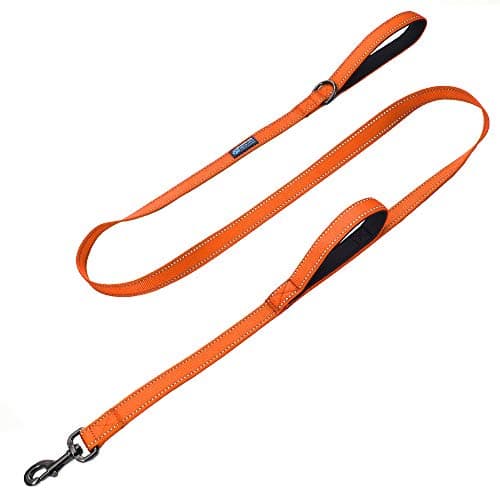
Rope or webbing? The only material question that matters here
Two of these three leashes are flat nylon webbing and one is round rope, and the difference shows up in your hand rather than on a spec sheet. Flat webbing under heavy load becomes a thin edge; that edge is what a slipping grip presses into. Round rope keeps its shape, so your fingers close around something. Plutus Pet publishes half-inch rock-climbing rope and says the leash is “perfect for extra large dogs”; Joytale publishes 1-inch nylon tape and describes it as thicker than a standard leash; Max and Neo publishes reflective nylon webbing with padded handles.
For a 25 lb dog this is irrelevant and you should buy on price and reflectivity. For a Labrador or anything bigger that genuinely lunges, the rope is worth the two dollars. And if your dog is strong enough that you are thinking about the leash at all, read our leash picks for large dogs next — it covers width, clip size and the hardware that actually fails first.
Where a traffic handle sits next to the other options
A second handle is one of three ways to get instant close control, and they are not interchangeable:
- A traffic handle keeps one leash doing two jobs. Cheapest, simplest, nothing to learn. The downside is bulk on a dog that never needs it.
- A double-ended leash clips to a harness front and back and lets you steer rather than hold. It does more, but it needs a two-ring harness and a bit of practice.
- A hands-free waist leash frees both hands for a running or stroller route, which is the opposite trade-off — see our hands-free picks. Several of those publish “dual handles” in their marketing, but the second grip is part of a waist setup rather than a true traffic handle, which is exactly why only three leashes qualified for this page.
What none of these three publishes
A breaking strength. Not one of Max and Neo, Plutus Pet or Joytale states a force rating for its webbing, its stitching or its clip, and only Joytale names the clip metal at all (“metal clasp”, with 360-degree rotation). Plutus Pet calls its clasp “large”; Mi Metty-style zinc-alloy or stainless grades are simply not stated anywhere in this group. The nearest thing to a published number in this whole site’s registry sits on car tethers rather than leashes, which is why our seat-belt roundup can compare hardware on numbers and this page cannot.
Treat “heavy duty” in this category as a marketing phrase, and rope diameter, webbing width, padding and swivel as facts. That is the whole basis of the order above.
How to actually use the low handle
Three habits make a traffic handle work and one makes it dangerous.
- Take it early, not late. Reach down when you see the cyclist, not when your dog is already mid-lunge. The handle is for prevention; once the dog is at the end of the line you are just absorbing force.
- Keep your elbow at your side. An arm held out in front gives the dog a running start. A short, locked arm beside your hip is far harder to pull off balance.
- Let go of it as soon as the thing has passed. A dog kept short learns that close means tense. Give the line back and reward the dog for walking on afterwards.
- Never wrap either handle around your wrist. This is the one that hurts people. A wrapped handle on a 70 lb dog that fires at a squirrel is a dislocated thumb or a broken finger; the whole point of the second handle is that you do not have to improvise one.
One more practical note on fit with the rest of your kit: a traffic handle works best clipped to a harness, not a collar. Hauling a dog in by its neck at close range is both unpleasant for the dog and, on a brachycephalic or small-breed dog, a genuine airway risk — our harness vs collar comparison covers why. If your dog also pulls hard on the main handle, the leash is only half the answer: a harness built for a strong puller does the other half, and our lunging guide covers the training that makes the low handle a once-a-walk tool instead of a permanent grip.