Why “heavy duty” nylon is not the answer
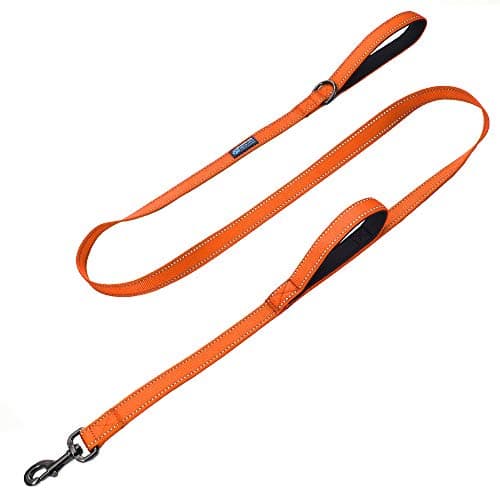
The leashes marketed hardest at chewers are thick nylon or climbing rope, and they fail for a structural reason rather than a quality one: a dog’s carnassial teeth work like scissors on fiber bundles. Making the bundle thicker makes it take longer, not make it survive. A 1-inch nylon lead buys you a few more minutes of chewing than a 5/8-inch one, and both end the same way.
That is why this page ranks a cheap steel cable above two good webbing leashes for the chewing problem specifically, and why we have not padded the list out with “tough” nylon leads just to have more picks. If you want the good flat leashes for ordinary wear, the leash hub ranks them, and the traffic-handle roundup covers the control hardware that often matters more than the material.
What biothane does and does not resist
Biothane is polyester webbing with a coating bonded to it, and the honest claim set is narrow but genuinely useful. It does not absorb water, mud, saliva or odor; it washes with soapy water; it stays flexible in cold; and it is what a lot of working trainers use for exactly those reasons — Jim Hodges’s listing describes it as the lead he uses daily and sells to his clients. What it does not claim, anywhere, is chew resistance. The listing’s own durability sentence contains the caveat in plain sight: it should last for years, “as long as your dog does not chew it”.
We are repeating that because it is the most useful honest line available in this category, and because the phrase “chew resistant” gets attached to biothane all over the internet by people who are not the manufacturer. Our biothane vs nylon comparison goes through the full trade-off, including the grip problem when the leash is soaking wet.
Living with a cable leash
If you buy the chew-proof option, know what you are getting. A coated cable does not drape; it holds coils from the packet for weeks, and it will not fold into a jacket pocket the way webbing does. There is no padded handle on the Mi Metty, which means a hard pull is unpleasant to hold, so it is not the leash for a dog that lunges — for that you want a padded line and a harness, which is the whole argument of our strong-puller harness roundup. A swiveling clip helps a lot with the kinking; Mi Metty publishes a zinc-alloy clip that rotates, which is one of the reasons it is the cable leash we rank.
A practical pattern that works well: keep the cable leash as the tie-out and waiting-around leash — outside a shop, in the yard, in the car footwell between walks, which is where most chewing actually happens — and walk on a padded nylon or biothane lead that you keep in your hand. The chewing happens when the dog is parked, not while it is moving.
Fix the chewing too, not just the leash
A chew-proof leash solves your expense problem. It does not solve the dog’s problem, and in a few cases it makes it worse — a dog that chews the lead out of arousal at the door is practicing arousal at the door, cable or not. The behavior side is covered in how to stop a dog chewing the leash, and the short version is: do not turn it into a tug game, give the mouth something legal to carry, and reward the walk-on. Puppies are usually a stage rather than a habit, and our puppy leash picks lean toward a cheap replaceable lead for exactly that reason.
One safety note that matters more than any material: never leave any leash on a dog that is chewing it while unsupervised, and that includes a cable. Swallowed coating, frayed wire strands and a line wrapped around a leg are all real hazards, and a chew-proof leash can give a false sense that the dog can be left to it. Check the whole length every few weeks and retire anything with a kinked cable, a cracked coating or a clip that has stopped swiveling — the same discipline our guide on when to replace a harness applies to the other end of the walk.