When a double leash is the wrong tool
This is the part most roundups skip, and it matters more than the hardware. A double leash physically ties two dogs together, which is fine for two dogs that walk reasonably and a genuinely bad idea in four situations:
- A big dog and a little dog. A 90 lb dog that lunges will drag a 12 lb dog off its feet, and no swivel prevents that. Walk badly mismatched dogs on separate leashes, one in each hand, or walk them separately.
- Either dog is reactive. A reactive dog needs the handler to create distance fast, and it cannot be done when the dog is bound to a second animal. Our reactive-dog leash picks exist for exactly this reason, and the reactive gear hub covers the rest of the setup.
- Either dog is still learning to walk on a loose leash. Training needs one dog, one handler and the ability to reward a specific moment. Teach each dog separately first — our two-dog walking guide sets out the order to do it in.
- The dogs are prone to scrapping. Two dogs that squabble should never be unable to move apart. The coupler removes the one thing that defuses most of it: distance.
Used on the right pair, though, a double leash is genuinely better than two leads: your second hand is free, the lines cannot cross into a braid behind you, and the dogs learn to move as a unit.
Clip the legs to harnesses, not collars
A coupler concentrates the force of two dogs at one point in your hand, and the force of the other dog at each dog’s attachment. On a collar, that lands on a neck; over a few hundred walks it is a lot of load in the wrong place, and on a small or flat-faced dog it is an airway risk. Clip each leg to a well-fitted harness. Our harness vs collar guide explains why, and harnesses for walking two dogs ranks the harnesses that pair well with a split leash.
Back-clip attachment is usually the better choice with a coupler, even though this site normally argues for a front clip. The reason is geometry: a front ring on a coupled dog pulls the dog across the other dog’s path, which is precisely the tangle you are trying to design out. If one of your pair pulls hard enough to need a front clip, that dog should be on its own leash until the pulling is fixed — see our loose-leash guide and harnesses for strong pullers.
What none of these three publishes
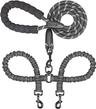
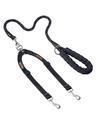
A strength rating of any kind. The AUTOWT names its hardware as all-metal with alloy swivel snaps, Mighty Paw names half-inch climbers’ rope, and iYoShop names climbing rope and woven nylon — but no figure, for any part, from any of them. That is worth knowing with a coupler specifically, because a double leash doubles the load on a single set of hardware. Judge them on published materials and swivel design, buy the size band that matches your heavier dog, and inspect the swivel and both snaps every few weeks.
The AUTOWT listing also states that its coupler can be used with a car seat belt. We are reporting that because it is the maker’s published copy, and we are not repeating it as a recommendation: a splitter is not a crash restraint, no part of it is crash-tested, and a dog in a car belongs in a crash-tested car harness or a crate. That distinction is the whole subject of what CPS certified actually means.
Two dogs, one hand: the practical setup
A few things that make the difference between a pleasant walk and a tangle:
- Shorten the faster dog’s leg. Every one of these three adjusts. Matching the dogs’ working length is the single biggest anti-tangle change you can make, ahead of any swivel.
- Keep the pair on the same side of you. Dogs that are allowed to swap sides wind the coupler up, and the swivel can only unwind so much.
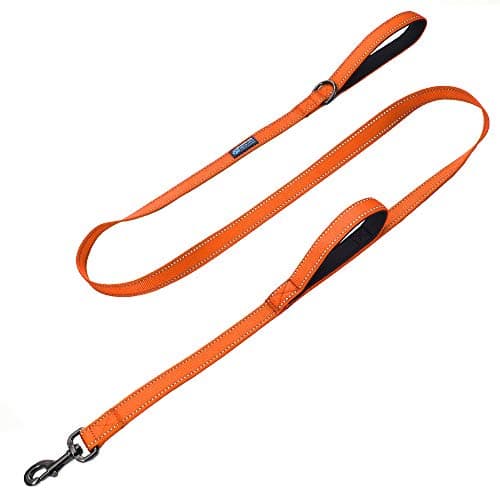
- Hold the handle, not the Y. Gripping the split puts your hand where both dogs’ force converges, which is how people get rope burn. If you want a second grip low down, that is what a traffic handle is for — on a single-dog leash.
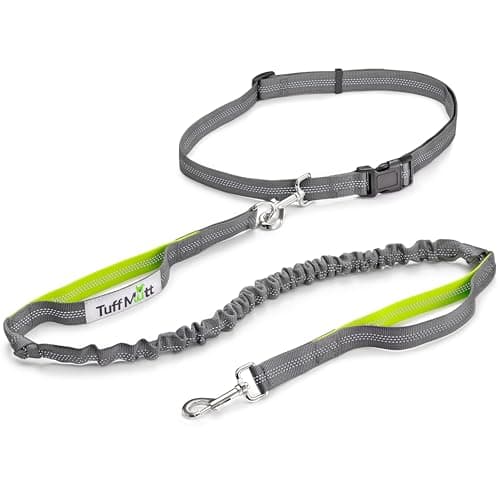
- Consider going hands-free instead. A waist-worn leash is a different answer to the same problem and works well for a running or stroller route; see our hands-free picks. The trade-off is that a waist belt gives you less ability to physically stop a dog quickly.