LEASH LOAM

Best Dog Seat Belts & Car Tethers

A dog seat belt is a connector, not crash protection - and the brands that make them say so on their own pages. Here are the short tethers worth buying, what each one actually claims, and the three rules that matter more than which you pick.

By Stephen V.Last verified How we pick

A “dog seat belt” is almost always a short strap with a clip on one end and something that grabs your car on the other. It costs very little, it takes ten seconds to fit, and it does one genuinely valuable thing: it stops your dog climbing into the front, pacing the back seat, or landing in your lap at a stoplight. That is worth having. What it is notis crash protection — and the most useful thing we can tell you up front is that the better brands admit this themselves. Kurgo prints “Designed to prevent distracted driving. Not crash tested” on its own product page for the tether we rate first here. Most roundups quietly skip that sentence. We think it is the single most important fact in the category, so we have built the whole page around it.

So read this as two answers, not one. If you want to stop a dog roaming the cabin, any of the first four picks does the job for about the price of a cheap leash, and the differences come down to where they anchor, how long they get, and whether your dog chews. If you want crash protection, no tether here provides it; that comes from a crash-tested harness used with the short tether it ships with, which is why the last pick is a harness rather than a strap. We have not crash-tested anything ourselves and never claim to. What we did was read each brand’s own published page for the strap length, the hardware and the exact wording of its safety claim, then check the setup against the Center for Pet Safety’s published guidance. If you are still weighing the two approaches, our dog car harness vs seat-belt tether guide covers the physics before you spend anything.

How this is funded:we earn a commission if you buy through our links, at no extra cost to you. It never changes which product we recommend, and we’ll tell you plainly when we’d skip one. Full disclosure.

Quick picks

Ranked on design, published specs and buyer fit. Select a row to jump to the full write-up. We have not hand-tested these — here is exactly what we do instead.

#ProductBest forPrice
1
Kurgo Direct to Seatbelt Swivel Tether

Kurgo Direct to Seatbelt Swivel Tether

The tether to buy if your harness didn't come with one: it plugs straight into the female slot of the car's seat-belt buckle, and the swivel carabiner stops the strap winding into a twisted mess on a long drive. Kurgo says plainly on its own product page that it is "not crash tested" and is designed to prevent distracted driving — believe them. It keeps a dog on the back seat and out of your lap; it is not crash protection.

Best seat-belt-buckle tether
$14.99 · View on Amazon

$18.9921% off

Price as of October 4, 2026. #ad How we’re funded

2
PetSafe Safety Seatbelt Tether

PetSafe Safety Seatbelt Tether

The cheapest sensible version of the same idea, and the only one here that publishes a hardware strength figure: PetSafe rates the stainless-steel carabiner to 725 lb and the nylon strap adjusts 15-22 in. A rated clip is not a crash test, and PetSafe makes no crash claim for it — but if the choice is this or a loose dog in the back seat, this is the better few dollars you'll spend.

Best budget tether
$9.94 · View on Amazon

Price as of October 4, 2026. #ad How we’re funded

3
Mighty Paw Dog Car Safety Belt (LATCH)

Mighty Paw Dog Car Safety Belt (LATCH)

This one skips the seat-belt buckle entirely and loops onto the car's LATCH bars — the same anchors a child seat uses — so it stays in the car between trips and never blocks a buckle a passenger needs. The strap adjusts 16-26 in with all-metal hardware and a swivel. Mighty Paw publishes no crash test for it, and anchoring to LATCH does not make an untested tether a crash restraint.

Best LATCH-anchor tether
$12.99 · View on Amazon

Price as of October 4, 2026. #ad How we’re funded

4
Mighty Paw Chew Proof Dog Car Safety Belt

Mighty Paw Chew Proof Dog Car Safety Belt

The answer to one specific, infuriating problem: a dog that chews through a nylon tether on every other drive. Mighty Paw builds this one from 2.34 mm braided stainless-steel cable — five bundles of seven wires — with an aviation-aluminum carabiner the brand publishes at 850 lb, anchored to the car's LATCH bars. It solves chewing, not crash safety: there is no published crash test for it either.

Best for dogs that chew
$14.99 · View on Amazon

Price as of October 4, 2026. #ad How we’re funded

5
Kurgo Enhanced Strength Tru-Fit Harness

Kurgo Enhanced Strength Tru-Fit Harness

The value pick for car safety: Kurgo crash-tested it to the FMVSS 213 child-restraint standard and includes the seat-belt tether in the box. Be clear on the wording though — it is manufacturer crash-tested, not certified by the independent Center for Pet Safety like the Sleepypod.

Best upgrade: a crash-tested harness instead
$38.87 · View on Amazon

Price as of October 4, 2026. #ad How we’re funded

The picks in full

#1Best seat-belt-buckle tether

Kurgo Direct to Seatbelt Swivel Tether

The tether to buy if your harness didn't come with one: it plugs straight into the female slot of the car's seat-belt buckle, and the swivel carabiner stops the strap winding into a twisted mess on a long drive. Kurgo says plainly on its own product page that it is "not crash tested" and is designed to prevent distracted driving — believe them. It keeps a dog on the back seat and out of your lap; it is not crash protection.

Strengths

  • Plugs into the seat-belt buckle slot, so there's nothing to thread or tie
  • Swivel carabiner keeps the strap from twisting as the dog turns around
  • Adjusts 15-22 in, short enough to keep a dog on the seat

Trade-offs

  • Kurgo states it is NOT crash tested — it limits movement, it does not protect in a crash
  • Kurgo lists it as incompatible with Volvo and not recommended for Ford F-Series trucks
  • Must clip to a harness, never a collar, and must never be used to extend a tested harness's own tether
TypeSeat-belt-buckle tether (swivel)
AttachmentCarabiner to harness; plugs into the seat-belt buckle slot
FitsAdjusts 15-22 in
MaterialNot published
Crash testNot crash tested (Kurgo's own product page)
Best forAny harnessed dog; Kurgo publishes no weight rating

Specs read from the product listing, on October 3, 2026. “Not published” means the brand does not state that figure.

#2Best budget tether

PetSafe Safety Seatbelt Tether

The cheapest sensible version of the same idea, and the only one here that publishes a hardware strength figure: PetSafe rates the stainless-steel carabiner to 725 lb and the nylon strap adjusts 15-22 in. A rated clip is not a crash test, and PetSafe makes no crash claim for it — but if the choice is this or a loose dog in the back seat, this is the better few dollars you'll spend.

Strengths

  • Stainless-steel carabiner published as holding up to 725 lb
  • Clicks straight into the seat-belt buckle; nothing to install
  • Adjustable 15-22 in nylon strap, and PetSafe says it works with any pet harness

Trade-offs

  • PetSafe publishes no crash test for it — this is a movement restrictor, not crash protection
  • PetSafe lists it as incompatible with Volvos and F-Series Ford trucks
  • A rated carabiner says nothing about how the whole setup behaves in a crash
TypeSeat-belt-buckle tether (budget)
AttachmentCarabiner to harness; clicks into the seat-belt buckle slot
FitsAdjusts 15-22 in
MaterialNylon strap, stainless-steel carabiner (published 725 lb)
Crash testNo crash-test claim published by PetSafe
Best forAny harnessed dog; no published dog-weight rating

Specs read from the product listing, on October 3, 2026. “Not published” means the brand does not state that figure.

#3Best LATCH-anchor tether

Mighty Paw Dog Car Safety Belt (LATCH)

This one skips the seat-belt buckle entirely and loops onto the car's LATCH bars — the same anchors a child seat uses — so it stays in the car between trips and never blocks a buckle a passenger needs. The strap adjusts 16-26 in with all-metal hardware and a swivel. Mighty Paw publishes no crash test for it, and anchoring to LATCH does not make an untested tether a crash restraint.

Strengths

  • Anchors to the vehicle's LATCH bars, leaving the seat-belt buckles free
  • Stays installed in the car — clip the dog's harness on and go
  • All-metal hardware and a swivel on a 16-26 in adjustable nylon strap

Trade-offs

  • No crash test published — LATCH anchoring is convenience and tidiness, not proven protection
  • Reaching between the seat cushions to find the LATCH bars is a one-time fiddle
  • Mighty Paw publishes no strength rating for this nylon version's carabiner
TypeLATCH-anchor tether (swivel)
AttachmentCarabiner to harness; loops onto the vehicle's LATCH bars
FitsAdjusts 16-26 in
MaterialNylon strap, all-metal hardware
Crash testNo crash-test claim published by Mighty Paw
Best forAny harnessed dog; no published dog-weight rating

Specs read from the product listing, on October 3, 2026. “Not published” means the brand does not state that figure.

#4Best for dogs that chew

Mighty Paw Chew Proof Dog Car Safety Belt

The answer to one specific, infuriating problem: a dog that chews through a nylon tether on every other drive. Mighty Paw builds this one from 2.34 mm braided stainless-steel cable — five bundles of seven wires — with an aviation-aluminum carabiner the brand publishes at 850 lb, anchored to the car's LATCH bars. It solves chewing, not crash safety: there is no published crash test for it either.

Strengths

  • 2.34 mm braided stainless-steel cable published as five bundles of seven wires — a chewer can't part it
  • Aviation-aluminum carabiner published at 850 lb
  • Anchors to LATCH bars and stays in the car between trips

Trade-offs

  • No crash test published — the cable resists teeth, which is not the same as crash protection
  • Fixed cable lengths (16, 24 and 32 in on the brand's page), so pick the size carefully — longer is not better in a car
  • Steel cable is heavier and less forgiving against a car door or a dog's leg than webbing
TypeChew-proof steel-cable LATCH tether
AttachmentCarabiner to harness; loops onto the vehicle's LATCH bars
FitsFixed cable lengths 16 / 24 / 32 in
Material2.34 mm braided stainless-steel cable, aviation-aluminum carabiner (published 850 lb)
Crash testNo crash-test claim published by Mighty Paw
Best forAny harnessed chewer; no published dog-weight rating

Specs read from the product listing, on October 3, 2026. “Not published” means the brand does not state that figure.

#5Best upgrade: a crash-tested harness instead

Kurgo Enhanced Strength Tru-Fit Harness

The value pick for car safety: Kurgo crash-tested it to the FMVSS 213 child-restraint standard and includes the seat-belt tether in the box. Be clear on the wording though — it is manufacturer crash-tested, not certified by the independent Center for Pet Safety like the Sleepypod.

Strengths

  • Manufacturer crash-tested to FMVSS 213, tether included
  • Doubles as a front-clip no-pull walking harness
  • Far cheaper than the CPS-certified options

Trade-offs

  • Brand-tested, NOT independently CPS-certified
  • A whole-vest fit is fiddlier than a simple belt clip
TypeBrand crash-tested car + walking harness
AttachmentSeat-belt tether + front & back walking rings
FitsXS–XL
MaterialNylon webbing, steel nesting buckle
Crash testBrand crash-tested (FMVSS 213, Calspan) — not CPS-certified
Best forMedium–large dogs

Specs read from the product listing, on July 22, 2026. “Not published” means the brand does not state that figure.

What a dog seat belt actually does

Picture the two jobs separately, because they are different problems with different solutions. The first job is containment: keeping a dog on its own seat so it cannot stand on the center console, put a paw on the gearshift, lean across your arm at an intersection, or hang its head out of a window. That is a real safety issue, because a distracted driver is a danger to everyone in the car long before any crash happens, and it is exactly the job a short tether does well. Clip it to the harness, plug the other end into the car, and the dog has enough slack to sit, stand and lie down on the seat and no more. Every pick below does this.

The second job is crash protection: managing the enormous forces that appear in a collision, when an unrestrained dog becomes a projectile and a restrained one has to have that energy spread safely across its body. This is an engineering problem, and a strap cannot solve it alone. A thin tether clipped to a thin harness concentrates the whole load of the dog’s body into a narrow line, which is the opposite of what you want. Crash protection comes from a broad, strength-rated vestthat spreads force across the chest and shoulders, with the tether as one short component of a tested assembly — not as the restraint itself. That is why “which dog seat belt is safest in a crash” has an uncomfortable answer: none of them, on their own. Our crash-tested car harness roundup covers the gear that is actually built and tested for that job.

How we chose

Because none of these products can be judged on crash performance — there is no crash data to judge, which is itself a finding — we picked on the things that are published and verifiable, in this order.

  • Short, controlled length. The tether should let a dog sit and lie down and nothing more. Every pick here sits in the mid-teens to mid-twenties of inches at full extension. Anything that advertises extra roaming room was excluded on purpose.
  • Where it anchors.A tether either plugs into the seat-belt buckle slot or loops onto the car’s LATCH bars — the same metal anchors a child seat uses. Neither is safer than the other in any tested sense; they suit different cars and different households, so we picked a best option for each.
  • Metal hardware, and any published rating.Molded plastic clips have no place on something connecting a dog to a car. We favored all-metal hardware and gave extra credit where the brand publishes an actual strength figure for the clip — PetSafe publishes 725 lb for its stainless carabiner, and Mighty Paw publishes 850 lb for the aviation-aluminum carabiner on its chew-proof cable.
  • A swivel. Dogs turn circles. Without a swivel a tether winds itself into a shortened, twisted cord over a long drive, which both annoys the dog and quietly changes how much slack it has.
  • Honest claim wording.We preferred brands whose own pages tell you what the product is and is not. Kurgo saying “not crash tested” raised our confidence in Kurgo rather than lowering it.
  • Vehicle compatibility, stated plainly. Both buckle tethers here are listed by their makers as incompatible with Volvos and not recommended for F-Series Ford trucks, whose buckle designs release differently. That detail turns a cheap purchase into a returned one, so it belongs in the picks, not the fine print.

One category is missing by design: zipline tethers, which run a line across the back seat so the dog can slide along it. We will not recommend one. The Center for Pet Safety excludes extension and zipline devices from its certification program and says they can negate any crash-protection claim the harness maker has made, because the extra travel lets a dog accelerate before the line goes tight — the clothes-line effect, with reported injuries up to catastrophic spinal damage. Giving a dog more room to move in a moving car is the one upgrade that makes everything worse.

The buckle tethers

The Kurgo Direct to Seatbelt Swivel Tetheris our first pick for the most practical of reasons: it is the version of this product with the fewest ways to get it wrong. One end is a swivel carabiner for the dog’s harness; the other is a metal tongue that clicks into the female slot of the car’s seat belt, exactly like a human belt. There is nothing to thread around a headrest, nothing to tie, and nothing to leave half-installed. Kurgo publishes an adjustment range of 15 to 22 inches, which is the right window — long enough for a dog to settle, short enough that it stays on the seat — and the swivel earns its keep on any drive long enough for a dog to turn around twice. The honest limits are the ones Kurgo states: it is not crash tested, it is listed as incompatible with Volvo, and it is not recommended for Ford F-Series trucks. Set it to the shortest length your dog can lie down in, clip it to a harness, and it does its one job well.

The PetSafe Safety Seatbelt Tetheris the same idea for less money, and it is the only tether here that publishes a hardware strength figure: PetSafe lists a stainless-steel carabiner holding up to 725 lb, on a nylon strap that extends 15 to 22 inches, and says it works with any pet harness. Treat that 725 lb carefully — it is a figure for one component, not a crash rating for the system, and PetSafe makes no crash claim for the product. But a published number on metal hardware is still more information than most of this category offers, and if the realistic alternative in your car is a dog riding loose because a tether felt like an extravagance, this is the cheapest way to fix that today. It carries the same Volvo-and-F-Series caveat as the Kurgo.

The LATCH tethers

Some cars make the buckle route awkward. If your back-seat buckles are needed for passengers, or you would rather leave the dog’s tether permanently installed, the Mighty Paw Dog Car Safety Beltloops onto the vehicle’s LATCH bars instead — the steel anchors between the seat cushion and the backrest that a child seat clips to. Mighty Paw publishes a 16 to 26 inch adjustment range, all-metal hardware and a swivel, and the design means the strap lives in the car: you clip your dog’s harness to it as they get in and unclip as they get out. Finding the anchors between the cushions is a one-time fiddle, and it is worth repeating that anchoring to LATCH does not confer crash protection on an untested tether — Mighty Paw publishes no crash test for it. What it buys you is a tidier, always-ready setup that never competes with a passenger’s seat belt.

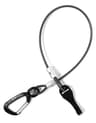
Then there is the dog that treats a nylon tether as a chew toy and is through it by the third trip. For that dog the Mighty Paw Chew Proof Dog Car Safety Belt is the specific fix: 2.34 mm braided stainless-steel cable, which the brand describes as five bundles of seven wires, finished with an aviation-aluminum carabiner it publishes at 850 lb, anchored again to the LATCH bars. A teething puppy cannot part a steel cable, so the problem simply stops. Buy it for that reason and no other, and buy the length carefully: the brand lists fixed 16, 24 and 32 inch cables, and in a car the shortest one your dog can comfortably lie down in is the right one — a 32 inch cable in a small back seat is slack you do not want. Steel is also heavier and less forgiving than webbing against a door frame or a leg, and, once more, there is no crash test behind it. If chewing is a wider problem in your house, our guide to dogs that chew the leash tackles the habit rather than just armoring against it.

The upgrade: a harness that was actually tested

If, reading all of that, what you actually want is crash protection, the honest recommendation is to stop shopping for straps and buy a harness that was built and tested as a restraint. The Kurgo Enhanced Strength Tru-Fitis our value pick for exactly that: Kurgo crash-tests it to the FMVSS 213 child-restraint standard and publishes the methodology, it uses a steel nesting buckle rather than plastic, and — the part that matters for this page — it includes its own short tether, which is part of the tested setup rather than an accessory you bolt on. It also works as an everyday front-clip walking harness, so one purchase covers two jobs. Be precise about what it is, though: it is manufacturer crash-tested, not independently certified by the Center for Pet Safety. For independent certification you are looking at a Sleepypod Clickit Sport, and our Sleepypod vs Kurgo comparison lays that value-versus-certified decision out side by side.

There is one trap to avoid at this point, and it is the most common mistake people make after reading a page like this: do notbuy a tested harness and then add one of the tethers above to it. A tested harness’s protection depends on its own short connection. Chaining an extra tether onto it lengthens the whole assembly, and per the Center for Pet Safety that is precisely what can negate the harness maker’s crash-protection claim. Use the harness’s own tether. Buy a separate tether only when your harness does not have one.

Three rules that matter more than which tether you buy

Clip to a harness, never a collar.This is the rule that cannot bend. A collar puts the entire load of a dog’s body into a narrow band across its throat, and in even a hard stop that risks crushing injury to the trachea and neck. Every brand here specifies the harness as the attachment point. If your dog travels in a collar today, the tether is the second purchase — the harness is the first, and our harness vs collar guide explains the anatomy behind the rule.

Keep it as short as the dog can tolerate. Length is the one variable you control after you buy, and shorter is categorically better in a car. The test is simple: your dog should be able to sit and lie down on its own seat, and should not be able to reach the footwell, put paws on the center console, or stretch toward the front seats. If it can do any of those, shorten the strap or buy a shorter size. Every extra inch is distance a dog can travel before the restraint engages.

Back seat, every time.The Center for Pet Safety is unambiguous that pets belong restrained in the back seat, away from active airbags and out of line with passengers’ heads. A front airbag deploys with enough force to seriously injure a dog, and a dog in the front is also the one most likely to end up in your lap. Our where should a dog ride in the car guide covers seat choice, cargo areas and crates in more detail.

Fitting and living with a dog seat belt

Installation is genuinely simple, but a couple of habits make the difference between a tether that works and one that quietly stops working. Fit the harness first and check it the way you would for the car — snug enough that you cannot pull a strap over the dog’s shoulder, loose enough for two fingers under the webbing. Clip the tether to the harness’s sturdiest attachment point, not to a decorative D-ring sewn onto a thin panel. Then shorten the strap while the dog is on the seat and watch what it can reach before you drive off.

After that it is a maintenance item, and it does age. Nylon that has spent a summer baking in a parked car gets stiff and chalky; a carabiner gate clipped twice a day for two years gets gritty and sloppy; a steel cable can kink where a door has closed on it. Look at it every few weeks, and replace it the moment the webbing is frayed or the clip no longer snaps shut cleanly — this is a part worth replacing early rather than late, the same logic we apply to retiring a harness on schedule. If your dog is new to riding restrained, introduce it in a parked car with treats over a few short sessions rather than on a two-hour drive; our introducing a dog to the car guide walks through the sequence, and the car-anxiety guide helps if travel itself is the problem rather than the gear.

Our honest bottom line: a short, metal-hardware tether clipped to a well-fitted harness in the back seat is a cheap, worthwhile upgrade over a loose dog, and the Kurgo swivel tether is the one we would buy first. Just hold on to what it is. You are buying a better-behaved car, not a safer crash — and if the crash is what you are thinking about, put the money into a harness that was crash-tested and use the tether it came with.

Frequently asked questions

Do dog seat belts actually work in a crash?

On their own, no, and the brands do not claim they do. Kurgo's own product page for its Direct to Seatbelt Swivel Tether says it is designed to prevent distracted driving and is not crash tested; PetSafe and Mighty Paw publish no crash-test claim for their tethers either. What a tether does well is keep a harnessed dog on its own seat and out of the front of the car, which is a genuine safety benefit while you are driving. Crash protection comes from a harness that was built and tested as a restraint, used with the short tether it ships with.

What is the best dog seat belt?

For most cars, the Kurgo Direct to Seatbelt Swivel Tether: it plugs straight into the seat-belt buckle slot, adjusts 15-22 inches, and the swivel stops the strap twisting as the dog turns around. The PetSafe Safety Seatbelt Tether does the same job for less and publishes a 725 lb stainless carabiner figure. If your back-seat buckles are needed for passengers, the Mighty Paw Dog Car Safety Belt anchors to the LATCH bars instead, and Mighty Paw's chew-proof steel-cable version is the fix for a dog that chews through nylon.

Can I clip a dog seat belt to my dog's collar?

No. A collar concentrates the entire load of the dog's body into a narrow band across the throat, risking crushing injury to the trachea and neck in even a hard stop. Every tether here specifies a harness as the attachment point. Clip to the strongest attachment point on a properly fitted harness, not to a collar and not to a thin decorative D-ring.

Should I add a seat-belt tether to a crash-tested harness?

No, if the harness already includes its own tether. A tested harness's protection depends on that short connection being part of the tested assembly, and the Center for Pet Safety warns that extension tethers can negate the crash-protection claims a harness maker has made, because the extra length lets a dog accelerate before the restraint engages. Buy a separate tether only when your harness does not come with one.

How long should a dog seat belt be?

Short. Your dog should be able to sit and lie down on its own seat and no more. If it can reach the footwell, put paws on the center console, or stretch toward the front seats, the tether is too long - shorten the strap or choose a shorter size. The tethers we recommend top out around 22 to 26 inches, and we deliberately exclude zipline and extension products designed to give a dog more room to move.

Are zipline dog tethers safe?

No. The Center for Pet Safety excludes extension and zipline devices from its certification program and states they can negate any crash-protection claim made by a harness manufacturer. The extra travel lets a dog build up speed before the line goes tight, producing a clothes-line effect across the body, with reported injuries ranging from orthopedic trauma to catastrophic spinal damage. Keep the connection short so the dog stays on the seat.

Sources

Keep reading