How the four picks compare for a puppy
Every figure below is read from the manufacturer’s own product page or the Center for Pet Safety’s certified list on the date recorded in our registry. Where a brand publishes no figure — including, importantly, where it publishes no crash test — the table says so rather than guessing.
| What matters with a puppy | Kurgo Tru-Fit | Mighty Paw Chew Proof | PetSafe Tether | Sleepypod Clickit Sport |
|---|
| What it is | Crash-tested car + walking harness | Steel-cable LATCH tether | Seat-belt-buckle tether | Crash-tested car harness |
| Crash status | Brand crash-tested (FMVSS 213, Calspan, dogs to 75 lb) — not CPS-certified | No crash-test claim published | No crash-test claim published | CPS-certified line (Clickit Sport, 5-star, 2014) |
| Size / fit range | XS–XL | Fixed cable 16 / 24 / 32 in | Adjusts 15–22 in | S–XL, up to ~90 lb |
| Grows with the puppy? | Yes — widest size run here, re-measure monthly | Not applicable — it is the tether, not the harness | Not applicable — it is the tether | Only within a size; sized for a grown dog |
| Chew resistance | Nylon webbing — chewable | Yes — 2.34 mm braided stainless-steel cable | Nylon strap — chewable | Ballistic nylon vest — chewable |
| Doubles as a walking harness? | Yes — front & back walking rings | No | No | Yes — back walking ring |
| Anchors to | Seat belt (tether included) | Vehicle LATCH bars | Seat-belt buckle slot | Seat belt (threaded) |
| Price tier | Mid | Budget | Budget | Premium |
Why the Kurgo Tru-Fit is the puppy pick
Two reasons, and the first is unglamorous: the Kurgo Enhanced Strength Tru-Fit comes in XS through XL, which means the harness you buy at four months has a bigger sibling at nine months with the same fitting routine and the same tether. A puppy owner is going to buy two or three sizes of something; buying them in one product line is how you avoid relearning the straps each time.
The second is that it is the only pick here that is both crash-tested and a genuinely good walking harness. Kurgo publishes its testing methodology, and the wording matters: this is manufacturer crash-testing to FMVSS 213 conditions at Calspan, not an independent Center for Pet Safety certification. Kurgo’s own methodology page lists 25, 50 and 75 lb test dummies and publishes excursion limits for dogs between 51 and 75 lb — which is comfortably above almost any puppy, and is the figure to remember when the dog grows past 75 lb and you need to move up to the Ruffwear or the certified Sleepypod.
The honest costs: fitting a whole vest on a wriggling puppy is fiddlier than clicking a tether into a buckle, and the webbing is chewable like any other. If your puppy is a chewer, the next pick is the companion purchase, not the alternative.
The chew problem, and the one product that solves it
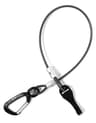
A teething puppy restrained in a back seat will find the tether. Mighty Paw builds the Chew Proof Dog Car Safety Belt from 2.34 mm braided stainless-steel cable — the brand publishes it as five bundles of seven wires — with an aviation-aluminum carabiner it rates at 850 lb, anchored to the car’s LATCH bars rather than the seat-belt buckle. A puppy cannot part it, which is the entire point.
Three honest caveats. Mighty Paw publishes no crash test for it, so this resists teeth and does not protect in a collision — pair it with the crash-tested harness above and you have both halves. The cable comes in fixed 16, 24 and 32 inch lengths, so pick deliberately: longer is not better in a car, because the shorter the tether the less the dog can move in a sudden stop. And steel cable is heavier and less forgiving against a door jamb or a puppy’s leg than webbing, so check where it lies when you close the door.
The cheap option, and when it is genuinely enough
The PetSafe Safety Seatbelt Tether clicks into the seat-belt buckle slot, adjusts 15 to 22 inches, and PetSafe publishes its stainless-steel carabiner as holding up to 725 lb. It is the cheapest sensible way to stop a harnessed puppy roaming the cabin. PetSafe publishes no crash test for it, so the same rule applies: this is a movement restrictor.
When is that enough? For the first few short trips, where the alternative is genuinely a loose puppy on a back seat, a tether clipped to a well-fitted walking harness is a real improvement and costs very little. Both this and the Kurgo tether are listed by their makers as incompatible with Volvos and not recommended for Ford F-Series trucks, so check your car before you order. Our full comparison of the four is on best dog seat belts and car tethers.
What to graduate to, and when
When the puppy stops growing, the Sleepypod Clickit Sport is the one restraint on this page with independent certification: a 5-star rating from the Center for Pet Safety, which crash-tests pet restraints itself rather than taking a brand’s word. It fits S to XL, up to roughly 90 lb, threads onto the seat belt, and spreads crash force across the chest and shoulders.
We put it last rather than first on a puppy page for one reason: it is the most expensive option here, and buying a premium harness for a body shape that will be unrecognizable in four months is the wrong order to spend money in. Buy the Kurgo now and the Sleepypod once the dog’s chest measurement stops moving. Sleepypod also sells Sport Plus and next-generation Clickit Range models direct, and certification applies to a specific model, so check the box you receive matches the one on the CPS list.
The first five car rides, in order
This is the AKC’s sequence, and it is worth following exactly, because a puppy that decides cars are frightening is a years-long problem.
One: introduce the harness or belt outside the car. Let the puppy sniff it, feed treats, praise, put it on for thirty seconds, take it off. Keep the sessions short and fun. Two: do the same in a parked, stationary car with the engine off, and reward calm behavior — lying down, not barking. Three: have someone else drive the first time so you can sit with the puppy and reward it. Four: the first trips go nowhere. A short drive down the street and back is the whole outing, specifically so that the car does not only ever mean the vet. Five: build up the length gradually, and on longer drives stop every few hours for a toilet break and water.
Then one habit to install from the very first ride: the puppy waits for a release cue before it gets out, on a leash, every time. A puppy that learns to launch itself out of an opening door is a puppy that will one day do it into a road. The rest of the car-anxiety work, for a puppy that has already decided it hates the car, is in how to introduce a dog to the car.