LEASH LOAM

Best Dog Leashes for Walking With a Stroller

Pushing a stroller leaves you one hand, or none. The leashes that keep a dog off the wheels and keep a sudden pull from steering the pram — and the one type to avoid.

By Stephen V.Last verified How we pick

The Max and Neo Double Handle Leash is the one to buy — and it is also the cheapest thing on this page, which almost never happens, so it is the budget pick as well as the top pick. The reason is the second handle sewn low on the line: pushing a pram you have one usable hand, and sliding that hand down to the traffic handle shortens the dog to your hip without stopping, letting go of the stroller or changing grip. It is the pick for any parent walking a dog that still pulls, surges at other dogs, or wanders in front of the wheels. The Mighty Paw Hands-Free Bungee is the best option if your dog genuinely does not pull and you want both hands on the handlebar, and the iYoShop is the cheapest way into that setup. The Viper biothane lead is here for one specific reason: it is the only leash we rank that can be wiped clean, which matters when the line spends its life at puddle height beside a wheel.

Prices are pulled from the live listings and stamped as of November 22, 2026. No price is written into this page’s text.

Why a stroller changes the answer

Every other hands-free page on this site, ours included, is written for runners. A stroller is the opposite problem and it is worth being precise about why, because the standard recommendation is actively wrong here.

  • A waist belt connects the dog to your center of mass. That is exactly what a runner wants — the dog’s pull is absorbed by your hips rather than your arm. Behind a pram it means a sudden lunge rotates your whole body, and your whole body is the thing steering 25 lb of stroller with a child in it.
  • You are already committed to a line of travel. On foot you can step sideways to deal with a dog. With a pram you cannot: the front wheels decide where you are going for the next second or two, which is precisely the window in which a dog problem happens.
  • The leash lives at wheel height. A long or slack line finds the wheels and the axle. The fix is not a shorter leash all the time — it is a leash you can shorten instantly, which is what a traffic handle is.
  • One hand is the realistic budget. Not none. Any setup that assumes two free hands has not been tested on a school run.

How this is funded:we earn a commission if you buy through our links, at no extra cost to you. It never changes which product we recommend, and we’ll tell you plainly when we’d skip one. Full disclosure.

Quick picks

Ranked on design, published specs and buyer fit. Select a row to jump to the full write-up. We have not hand-tested these — here is exactly what we do instead.

#ProductBest forPrice
1
Max and Neo Reflective Double Handle Leash

Max and Neo Reflective Double Handle Leash

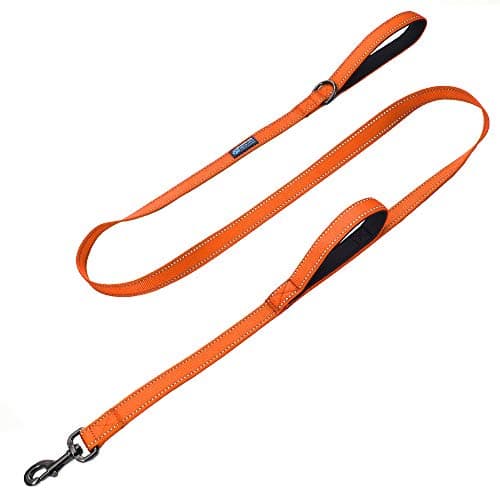
The leash that actually helps with a puller: a second handle down near the clip lets you choke up and keep the dog close past a distraction, then let out to full length again. Reflective, well-built, and the company donates one to a shelter for every leash sold.

Best overall and budget pick: one-handed control
$16.99 · View on Amazon

Price as of November 22, 2026. #ad How we’re funded

2
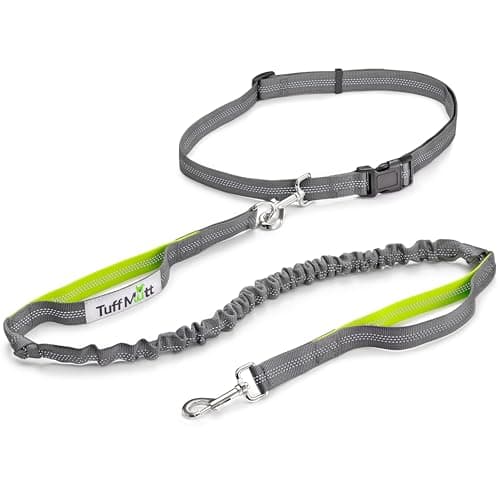
Mighty Paw Hands-Free Bungee Leash

Mighty Paw Hands-Free Bungee Leash

A step up in build for runners who go out often: a reflective bungee leash with a sturdier belt and hardware than the budget options. If hands-free is your default and you want it to last, this is the upgrade over a bargain set.

Best hands-free, if your dog does not pull
$22.50 · View on Amazon

Price as of November 22, 2026. #ad How we’re funded

3
iYoShop Hands-Free Dog Leash

iYoShop Hands-Free Dog Leash

A budget hands-free leash that covers the basics well: an adjustable waist belt, a bungee section for shock absorption, and two padded handles for when you need to take control back. The value pick if you want to try hands-free walking without spending much.

Cheapest way into a hands-free setup
$15.83 · View on Amazon

$21.9928% off

Price as of November 22, 2026. #ad How we’re funded

4
Viper Biothane Dog Leash

Viper Biothane Dog Leash

Biothane is coated webbing that shrugs off water, mud and dog slobber and wipes clean — the leash for swampy trails and dogs that like to chew a wet lead. It doesn't hold odor the way soaked nylon does, which is the whole reason to pay a little more.

Best for wet pavement and a muddy line
$21.59 · View on Amazon

$26.9920% off

Price as of November 22, 2026. #ad How we’re funded

The picks in full

#1Best overall and budget pick: one-handed control

Max and Neo Reflective Double Handle Leash

The leash that actually helps with a puller: a second handle down near the clip lets you choke up and keep the dog close past a distraction, then let out to full length again. Reflective, well-built, and the company donates one to a shelter for every leash sold.

Strengths

  • Traffic handle near the clip for instant close control
  • Reflective stitching along the whole length
  • Padded main handle and a genuinely tough clip

Trade-offs

  • A fixed-length lead, so it won't give a dog room to range on trails
  • The second handle is bulk you don't need on a non-puller
TypeDouble-handle traffic leash
AttachmentBolt snap
Fits6 ft · 4/5/6 ft widths available
MaterialReflective nylon webbing, padded handles
Best forMedium–large pullers

Specs read from the product listing, on July 22, 2026. “Not published” means the brand does not state that figure.

#2Best hands-free, if your dog does not pull

Mighty Paw Hands-Free Bungee Leash

A step up in build for runners who go out often: a reflective bungee leash with a sturdier belt and hardware than the budget options. If hands-free is your default and you want it to last, this is the upgrade over a bargain set.

Strengths

  • Heavier-duty belt and hardware than budget hands-free leashes
  • Reflective bungee leash for low-light runs
  • Comfortable for frequent, longer sessions

Trade-offs

  • Costs more than a basic hands-free set
  • Still less instant control than a handheld leash near triggers
TypeWaist-worn bungee hands-free leash
AttachmentBolt snap on a bungee section
FitsWaist belt 36–48 in · dogs up to 150 lb
MaterialReflective nylon webbing, elastic bungee
Best forMedium–large active dogs

Specs read from the product listing, on September 29, 2026. “Not published” means the brand does not state that figure.

#3Cheapest way into a hands-free setup

iYoShop Hands-Free Dog Leash

A budget hands-free leash that covers the basics well: an adjustable waist belt, a bungee section for shock absorption, and two padded handles for when you need to take control back. The value pick if you want to try hands-free walking without spending much.

Strengths

  • Adjustable waist belt plus two control handles
  • Bungee section softens the jolt of a pull
  • Inexpensive way to test whether hands-free suits you

Trade-offs

  • Webbing and buckles are budget-grade
  • Less refined than premium hands-free systems
TypeWaist-worn bungee hands-free leash
AttachmentBolt snap on a bungee section
FitsAdjustable waist belt · dual handles
MaterialNylon webbing, elastic bungee, reflective stitching
Best forSmall–large active dogs

Specs read from the product listing, on July 22, 2026. “Not published” means the brand does not state that figure.

#4Best for wet pavement and a muddy line

Viper Biothane Dog Leash

Biothane is coated webbing that shrugs off water, mud and dog slobber and wipes clean — the leash for swampy trails and dogs that like to chew a wet lead. It doesn't hold odor the way soaked nylon does, which is the whole reason to pay a little more.

Strengths

  • Waterproof coated webbing wipes clean and won't hold smell
  • Stays supple in cold and doesn't stiffen when wet
  • Very hard-wearing for the price

Trade-offs

  • Can feel slick in the hand when soaking wet
  • Fewer soft-handle options than padded nylon leashes
TypeWaterproof biothane leash
AttachmentBolt snap
Fits4/6 ft · multiple widths
MaterialCoated biothane webbing
Best forAll sizes; match the width to the dog

Specs read from the product listing, on July 22, 2026. “Not published” means the brand does not state that figure.

How to run the leash past a stroller

Two arrangements work, and which one you want depends on your dog rather than your stroller.

Dog on the outside, leash in the outside hand. This is the default and it is the one the traffic handle is built for. The dog walks on the far side of you from the road, you push mostly one-handed, and the second handle gives you an instant shortening when someone approaches. The cost is that you are pushing with one arm, which is fine on a flat sidewalk and tiring on a hill.

Leash around the waist, both hands on the handlebar. Only for a dog that walks on a loose leash already. If you take this route, a bungee section is not a luxury: it takes the sharp edge off a small pull before it reaches your hips. The Mighty Paw belt adjusts 36–48 inches and its maker rates it for dogs up to 150 lb, which is a strength claim about the hardware and not a recommendation that a 150 lb dog should be attached to you behind a pram. It should not be.

What does not work is wrapping the leash around a stroller handle. It feels tidy and it removes your ability to let go, which is the one safety valve you have if the dog bolts after something. Never attach a dog’s leash to the stroller itself, for the same reason.

The one leash type to leave at home

A retractable. Behind a pram it fails three different ways at once: the thin cord is invisible at wheel height, the brake needs a dedicated thumb you do not have, and the default state of the product is “dog somewhere out in front of you” — which beside a stroller means the dog is in the blind spot created by the pram’s own canopy. Our full argument is in why retractable leashes are bad, and non-retractable leashes ranks the fixed replacements. A long line has the same problem with less excuse; it is an open-space recall tool, and a sidewalk is not open space.

Fix the pulling at the harness, not the leash

A leash does not stop a dog pulling — it only decides where the pull goes. If your dog drags you, the stroller makes that unsafe rather than merely annoying, and the component that changes it is the harness: moving the leash connection to the chest turns a forward pull into a turn back toward you. Start at the no-pull harness hub, or training harnesses if you are actively working on it. For a dog strong enough that a harness is not enough, a head halter gives far more control per pound of force, which is the honest recommendation for a parent who is also pushing a pram.

Be realistic about the combination, too. A dog that lunges at other dogs should not be walked next to a stroller while that is still true — not because of the gear, but because you cannot manage distance and a pram at the same time. Our reactive-dog gear section covers the management, and pulling toward other dogs covers the training. Two adults, or two trips, is a better answer than any product on this page.

Length, and the detail nobody mentions

Four to six feet is the working range. Six feet with a traffic handle is the most useful single configuration, because the handle effectively gives you a four-foot leash whenever you want one — our guide to what length leash you need lays out the trade.

The detail nobody mentions: the clip. Standing behind a pram you cannot see the dog’s harness, so you are clipping and unclipping one-handed and blind, often with a child on your hip. A bolt snap you can work with a thumb is worth more in practice than any amount of webbing specification. All four picks here use a bolt snap; the Viper and the Max and Neo are the two you can operate without looking. For more on matching leash to dog, see how to choose a dog leash.

Keep reading

Frequently asked questions

What is the best dog leash for walking with a stroller?

A six-foot leash with a traffic handle — the Max and Neo double-handle leash is our pick, and it is also the cheapest leash here. Pushing a pram you have one usable hand, and sliding it down to the second handle shortens the dog to your hip instantly without stopping or changing grip. That instant shortening is the single most useful thing a leash can give you in this situation.

Should I use a hands-free waist leash with a stroller?

Only if your dog already walks on a loose leash. A waist belt attaches the dog to your center of mass, which is what a runner wants and the opposite of what you want when your body is steering a loaded stroller — a lunge rotates you and the pram together. If you do use one, pick a belt with a bungee section so a small pull is absorbed before it reaches your hips.

Can I tie the dog's leash to the stroller?

No. Attaching the dog to the stroller, or wrapping the leash around the handlebar, removes your ability to let go — which is the one safety valve you have if the dog bolts after something. It also means anything the dog does is applied directly to a pram with a child in it. Keep the leash in your hand or on your waist, never on the frame.

Is a retractable leash okay for stroller walks?

It is the worst choice here. The thin cord is invisible at wheel height, the brake needs a thumb you do not have, and the product's default state puts the dog out in front of you — which, beside a pram, is the blind spot created by the canopy. A fixed six-foot lead with a traffic handle does the same job with none of that.

Sources

Keep reading