Why nylon is the wrong material at the beach
A standard leash is woven nylon webbing. Woven webbing is thousands of fiber bundles with air between them, which is exactly the structure that makes it strong, light and cheap — and exactly the structure that holds water. Dunk it in the sea and it absorbs salt water; let it dry in the sun and the salt crystallizes inside the weave. The result is a lead that feels board-stiff the next morning, abrades a bit more against your hand each time, and traps fine sand in the same spaces. It is not a safety problem. It is a comfort and longevity problem, and it is why people quietly replace their beach leash every season or two.
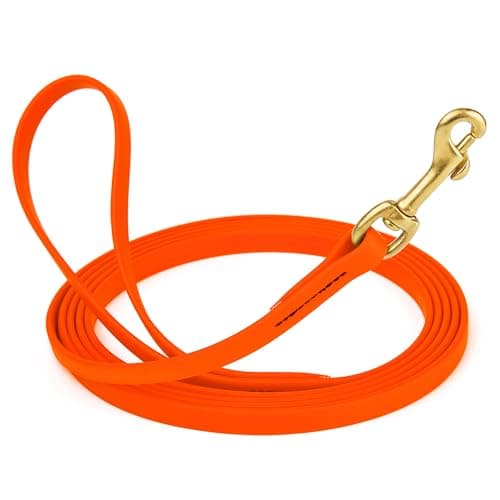
Biothane is the structural answer rather than a treatment: a webbing core sealed inside a smooth coating, so there is no weave for water, salt or sand to enter. Viper publishes that it wipes clean and will not hold smell, that it stays supple in cold and does not stiffen when wet, and the registry entry we keep for it says the same. Rinse it under a tap, wipe it, done. The trade-off is real and worth knowing before you buy: coated webbing can feel slick in the hand when it is soaking wet, and there are fewer padded-handle options in biothane than in nylon. If your dog pulls hard and you want a cushioned grip, that is a genuine argument for staying with nylon and accepting the stiffness — or for clipping to a no-pull harness so the pull stops being the thing your hand has to absorb.
Hardware is the part that fails in salt air
Webbing rarely breaks. Clips seize. Salt air corrodes plated steel snap hooks and spring gates, and the failure mode is not dramatic — the gate gets gritty, then sticky, then one day it does not close fully and you do not notice. This is the quietest reason a beach leash should be treated as a different purchase from a sidewalk leash.
Two of our picks say something specific about this and two do not, and we are going to be straight about which. The Rogue Long Line publishes an anodized 6061-T6 aluminum lockable screwgate carabiner— anodized aluminum is specified for corrosion resistance, and a screwgate is a gate you close deliberately rather than one that relies on a spring. That is the best hardware story on this page. The Viper, the Tuff Mutt and the Max and Neo all use standard bolt snaps and publish nothing about corrosion treatment, so treat the rinse as part of using them: fresh water over the clip, work the gate a few times, let it dry open. Do that and a cheap snap lasts years. Skip it all summer and it will not.
Length: the beach is where a long line earns its keep
Most places you walk a dog, a long line is a liability — it tangles in brush, wraps around posts and trips other people. An open beach removes all three problems and adds the one thing a long line needs: sightline. You can see a hundred yards of approaching dog, jogger or kite in time to reel in. That combination makes the beach the single best place to use twenty feet of line, and the reason we rank a long line second rather than treating it as a specialist’s tool.
The Rogue is the pick because of what Ruffwear publishes about it: a single published length of twenty feet at three-quarter-inch width in Tubelok polyester webbing, and a handleless design that drags freely without snagging. Handleless matters more on sand than anywhere else — a loop at the end is what catches on driftwood and buries itself. Its honest cons: there is no handle to grab in a hurry, so you stop a dog by putting a foot on the line rather than by taking hold, and twenty feet of anything needs managing. It is also the most expensive pick here. If you want more line for less money, the Leashboss Long Traineris nylon, which on this page is the material caveat again — good value, worse after a summer of salt. Technique first either way: long-line training covers how to use the length without rope-burning your hands, and what length leash you need covers the everyday case.
One thing a long line is not: permission to let go. Off-leash beach rules vary by town and by season, a long line is still a leash for the purposes of most of them, and a dog trailing twenty feet of webbing in surf is a dog that can get wrapped. Check the posted signs, and if your dog’s recall is not reliable around other dogs, the line is the tool that keeps that honest.
Hands-free works at the beach for a specific reason
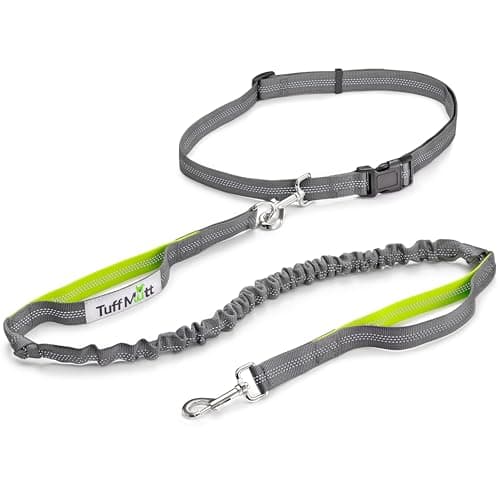
A waist-worn leash is usually sold to runners. The beach case is different: you are walking a long way at low speed, often carrying something, over a surface that makes you work for every step. Clipping the dog to your waist for a two-mile stretch of flat sand is genuinely pleasant, and the Tuff Mutt is our pick for it — an adjustable belt with two D-rings and a bungee section that absorbs the jolt of a sudden lunge rather than transmitting it into your lower back.
The cons are the ones that apply to every hands-free setup, and the beach does not soften them. Hands-free means less instant control near a real trigger — and a beach is full of them, from a loose dog to a gull to a child with a ball. It is also not the tool for teaching a hard puller to stop pulling; the bungee hides the pull rather than fixing it. Use it with a harness that does the redirecting, and read the full hands-free roundupif that is the lane you want. If your dog reacts to other dogs, a beach is a high-trigger environment and a waist belt is the wrong choice — start with leashes for reactive dogs instead.
What else the sand does to a dog
Two things worth knowing that no leash fixes. First, hot sand. The AKC uses a simple test for walking surfaces in heat: place your hand comfortably on the surface for ten seconds, and if it is too hot for your hand it is too hot for your dog’s paw pads — and it notes that at an air temperature of 86°F asphalt registers 135°F. Dry mid-afternoon sand behaves far more like asphalt than like grass. Walk the waterline, go early or late, and read what temperature is too hot to walk a dog before a summer beach day.
Second, what the leash is clipped to. A wet dog shrinks: coat flattens, and a harness that was snug on the drive over is looser on the walk back. That is the classic set-up for a dog backing out of its harness on exactly the terrain where it can run furthest — so re-check the fit after the first swim, and if your dog has ever reversed out of anything, use a design built for it (escape-proof harnesses) and clip a backup connection to a collar. For a dog that pulls toward the water the whole way there, our no-pull harness picks are the other half of the setup.
How to choose between these four
- One leash, many beach days: Viper Biothane. Rinse, wipe, hang up.
- Open sand and a dog that wants to run: Ruffwear Rogue Long Line, with the recall work to match.
- Long flat walks, hands busy: Tuff Mutt hands-free belt, over a harness that handles the pulling.
- Spending as little as possible:Max and Neo. Reflective nylon with a traffic handle for close control — just rinse it every single time.
And the honest summary of the whole page: if you already own a decent nylon leash, you do not strictly need a beach leash. You need to rinse the one you have, every time, including the clip. The reason to buy biothane is that it removes the step you will eventually stop doing. For the wider field, start at our leash roundup, or leashes for hikingif mud and trail are the bigger part of your year — and biothane vs nylon is the material comparison in full.