Why a small dog is the hardest muzzle to fit
Three things work against you, and they compound. First, there is simply less nose: a basket that is a centimeter too long on a Labrador is still a working muzzle, while the same error on a terrier puts the front of the basket past the nose and the strap into the eyes. Second, a small dog’s head and neck are closer in circumference, which is the same geometry that lets small dogs back out of collars and harnesses — a muzzle strap that is one notch loose comes off over the skull rather than staying put. Third, the fit tolerance is smaller in absolute terms, so the same percentage error that is forgiving on a big dog is the difference between “wears it” and “paws it off in four seconds”.
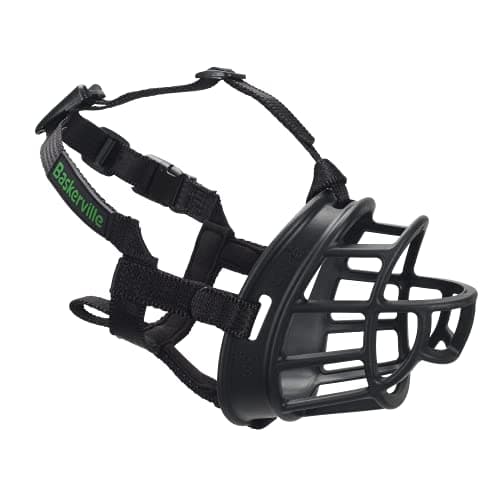
Which is why this page ranks the same three muzzles our basket muzzle roundupranks, in a different order. There, the question is which muzzle does which job — bite safety, scavenging, the vet’s exam room. Here the question is which one can be made to fit a small dog at all, and that puts the ten-size Classic first and the clever heat-moldable Ultra second rather than the other way round.
Measure before you choose, and use the nose length
Both Baskerville product pages publish the same two measurements and the same rule for when they disagree. You need your dog’s nose length and its nose circumference, and in Company of Animals’ own words, where the two measurements fall into different size categories, “please use the nose length measurement to determine the best size”. On a small dog those two figures disagree often — a short, broad muzzle is common in small breeds — so the tiebreaker rule does real work here rather than being a footnote.
We are not going to print per-size numbers, and you should be suspicious of pages that do. Company of Animals publishes its size figures only inside a sizing-guide imageon each product page, not as text we can quote, so the honest instruction is: measure your dog, open the sizing guide on the brand’s own product page, and match. What the brand does state in text is that the Ultra is “available in a variety of sizes, making it ideal for small, medium and large dogs” and that the Classic is “available in 10 sizes to find the perfect fit for your dog”.
One practical warning that catches people out on Amazon: each Baskerville size is sold as its own listing. The buy buttons here open one representative size, so use the size selector on the listing after you have measured. Ordering the wrong size is the single most common reason a muzzle ends up in a drawer, and a muzzle in a drawer protects nobody.
The Classic’s ten sizes are the reason it leads
Ten published sizes against six is not marketing; it is a finer grid, and a finer grid is what a small dog needs. Company of Animals also recommends the Classic specifically for “German Shepherds, Dachshunds, Greyhounds & other longer nosed breeds” — and the Dachshund in that list is the useful one for this page, because a long, narrow, low muzzle is a shape the standard six-size run handles badly. Italian Greyhounds, Min Pins, small terriers and other narrow-nosed small breeds sit in the same bracket.
Its honest cons, which matter more at this size: the Classic ships with an anti-scavenging guard layer, and with the guard fitted you cannot pass treats through it— treats are how a dog learns to accept a muzzle, so train with the guard out and add it later if scavenging is the problem you are solving (that is the job of muzzles for a dog that eats everything). It also publishes no headstrap, so the neck strap and collar loop are the only security — on a small dog whose head is nearly as wide as its neck, that is the weakest point of the three. And ten sizes means ten chances to order the wrong one.
The Ultra lets you fix a size chart that does not fit
This is the pick for the small dog that falls between sizes, which is most of them. The brand publishes that the Ultra is thermoplastic rubber that can be softened in hot tap water and molded to your dog’s nose — so instead of accepting the nearest size, you reshape the basket. On a small muzzle, where a few millimeters decide whether the basket clears the nose, that is the most useful feature on this page. The Ultra is also the one design Cornell’s Riney Canine Health Center names by name when it points owners at basket muzzles, and the only one of the three that publishes a headstrap in addition to the collar loop— the brand strongly recommends using both while a dog is still learning to wear it, and that second anchor is what stops a small dog pulling the muzzle off over its skull.
Against it: the molded shape relaxes. In the brand’s own words the material “will return to its original shape over time”, so a molded fit needs redoing periodically. It runs six sizes rather than ten, so a very long narrow nose may still fit the Classic better. It costs more than the Classic. And like every muzzle here it is the wrong tool for a flat-faced breed.
The INVISA answers the reason small-dog owners skip muzzling
There is a particular social problem with muzzling a small dog: a muzzle on a Labrador reads as responsible, and a muzzle on a ten-pound dog draws stares and comments. That is not a performance issue, and it is still the reason plenty of small dogs that should wear one do not. The INVISA is a transparent basket that Company of Animals describes as less visible on the dog, with a 360-degree padded basket and the same published ability to pant, drink and take treats.
We are clear about what that claim is: an appearance claim, not a performance one. A stranger who looks twice still sees a muzzle. It is also the most expensive of the three for the same size, it publishes no headstrap (the collar loop is the only backup), and the heat-molded shape relaxes over time exactly as the Ultra’s does. We rank it because a muzzle an owner will actually put on is worth more than a better muzzle they will not.
What a muzzle does not do for a small dog
It does not reduce reactivity, and it does not stop barking — a basket muzzle leaves the mouth open enough to pant, drink and bark, which is the design working as intended. It buys safety while the real work happens, and the real work is distance, management and reward-based training; how to muzzle train a dog is the step-by-step, and the rule that matters most on a small dog is to go slower than you think you need to. Never leave a muzzle on an unattended dog, and never attach a leash to one.
Two neighboring tools get confused with this one, more often on small dogs than large. A head halter is not a muzzle— it steers the head and leaves the mouth free, so it cannot prevent a bite; head halter vs muzzle sets out which job each does. And a soft fabric sleeve is not a basket muzzle: it holds the jaws closed, which stops a dog panting, and a dog cools itself by panting. Those are for a brief vet procedure under supervision, not for a walk. If the problem you have is a small dog that lunges and barks rather than one that might bite, reactive-dog gear for small dogs is the right page, and if it has bitten or might, muzzles for a dog that has bitten ranks these same three on bite security instead of fit.
How to choose between these three
- Narrow or long-nosed small dog, or you want the widest fit grid: Baskerville Classic — ten sizes, cheapest, train with the guard removed.
- Your dog falls between sizes: Baskerville Ultra. Mold it in hot tap water, and use the headstrap as well as the collar loop.
- You will not muzzle in public because of how it looks: Baskerville INVISA.
- Flat-faced small breed:none of these. Ask your vet — this category does not serve brachycephalic dogs.